If you have ever sat through a long blackout with your phone at 4% and your laptop at 10%, you already understand why people buy power stations. The light goes, the router goes, the fan stops, and suddenly you are rationing battery like it is fuel in a queue.
The itel Power Go Pro is one of the smaller answers to that problem. It is not a generator, and it is not a full solar system. It is a compact box with a battery inside and a standard socket on the front, and for many everyday situations, that is all you need. This article explains what it is, what it can and cannot do, and who should buy it, so you can decide before you spend any money.
What Is the itel Power Go Pro? Everything a Nigerian Buyer Should Know Before Paying
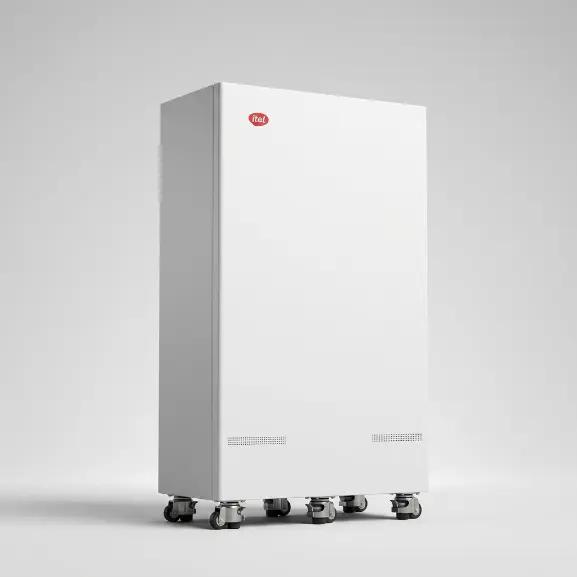
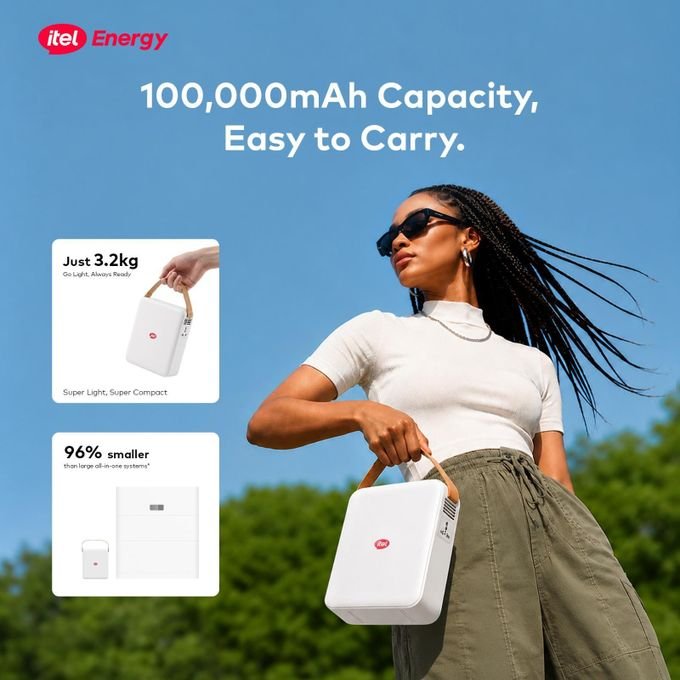
The itel Power Go Pro (model IESS-320ACT) is a portable power station with a 320Wh lithium iron phosphate (LiFePO4) battery and a 200W AC socket. The listing describes it as a 100,000mAh power bank with an AC outlet, which is how many people search for it. It weighs 3.2kg, has a carry handle, and can be recharged from the wall or from a small solar panel.
In plain terms: you can charge a laptop with its normal charger, run a small TV or a fan, keep your WiFi router on, and charge several phones, all without fuel and without noise.
What comes in the box
- the itel Power Go Pro itself
- a 65W fast wall charger
- a Type-C to Type-C cable
- a user manual and warranty documents
That charger matters. Some small power stations make you buy the charger separately, which adds to the real cost. Here it is included.
The ports, one by one
The front of the unit carries one 220–240V AC socket rated for up to 200W, one USB-C port with 65W Power Delivery, four USB-A ports, and four DC5521 ports. The DC and USB outputs together can supply up to 133W.
The AC socket is the reason this model exists. Plain power banks cannot charge a laptop that uses a standard charger, and they cannot run a small TV or a table fan. The Pro can, as long as the total stays under 200W.
The battery
Inside is a 320Wh LiFePO4 battery, rated for more than 3,000 charge cycles. If you want the background on why this chemistry is a good choice, we cover it in our article on LiFePO4 batteries. The short version is that it is built to last years and handles heat better than ordinary lithium-ion cells.
The 320Wh figure is the honest measure of how much energy it stores. The “100,000mAh” label is a marketing equivalent, and we explain why in our article on watts, watt-hours and mAh.
Display and light
A small digital screen shows the battery level and the watts going in and out. This is more useful than it sounds. Once you can see that your laptop is pulling 55W, you stop guessing how long the battery will last. There is also a 2W LED light with several brightness levels and an SOS mode, handy when the whole house is dark and you cannot find your phone.
Recharging
You can charge the Power Go Pro from the wall using the 65W charger, from a faster USB-C source of up to 100W, or from a solar panel through the solar input, which accepts 11–24V at up to 100W. No tested charge time is published, so our figures are calculations: about 5 to 6 hours on the 65W charger and roughly 3.5 to 4.5 hours at 100W.
What it can run
Anything that draws 200W or less. In practice that means:
- laptops on their normal chargers (usually 45–65W)
- a WiFi router or modem (about 10–15W)
- LED bulbs (about 10W each)
- small LED TVs and table or standing fans (roughly 40–60W)
- CCTV systems of a couple of cameras and a DVR (30–40W)
- phones, tablets, earphones, speakers and power banks
We give calculated run-times for each of these in our article on what a 200W power station can run.
What it cannot run
We would rather say this clearly than have you find out the hard way. The Power Go Pro is not for air conditioners, kettles, irons, hot plates, or heavy refrigerators and freezers. Anything with a heating element or a big motor will either exceed 200W or surge past it when it starts. If you need that kind of power, you are looking at a larger unit such as the itel Power Tank range or a proper solar and inverter setup.
Power Go or Power Go Pro?
The base itel Power Go has the same 320Wh battery but no AC socket. If all you charge are phones and USB-C devices, it will do the job for less money. If you have a laptop with a regular charger, a TV or a fan, the Pro is the one to buy. Power Go at roughly ₦80,000 and the Power Go Pro is ₦140,000.
Who it suits
Freelancers and remote workers who cannot afford to drop off a call. Students and hostel residents. Small shop owners who need a router, bulbs or CCTV to stay on. Families who want a quiet backup for the TV and the fan. And anyone who wants to start with solar without spending on a big system.
A few honest cautions
Keep the side vents clear and do not cover the unit while it works. Keep it dry. Warranty terms published by itel Energy exclude water damage, lightning, impact and removed serial labels, so keep your receipt and the serial number. And remember that the run-times you read here are estimates based on the battery size, not lab tests.
What a normal day with it looks like
It helps to picture how this works in a real house, because the product is simpler than the specs make it sound.
In the morning, the unit sits near a wall socket, plugged into its 65W charger, battery full. Nothing about it demands attention. Around midday, the light goes. You do not touch it. If your router and a lamp are plugged into the power station through an extension strip, they simply keep going, because the unit is already supplying them. In the evening, you plug in the laptop and the TV. You glance at the display, see about 100W going out, and know you have a couple of hours to spare. When the light returns after midnight, you leave the charger connected and go to bed. By morning the battery is back to full.
That is the whole routine. There is no fuel to buy, no engine to start and no noise to apologise for. The main habit to build is simple: keep it charged whenever the light is on, so that it is ready before you need it.
A small warning from experience: people who forget to recharge are the people who complain. A power station that is half empty when the outage begins will not give you the hours you expected. Put a reminder on your phone if you need one.
Where to buy it
At PA DigiTech, we sell the genuine itel Power Go Pro at ₦140,000. You can see the full details and place your order on our itel Power Go Pro product page, or call us on 07068853073 if you would like to talk through your devices first. Tell us what you want to run and we will tell you honestly whether 200W is enough.