
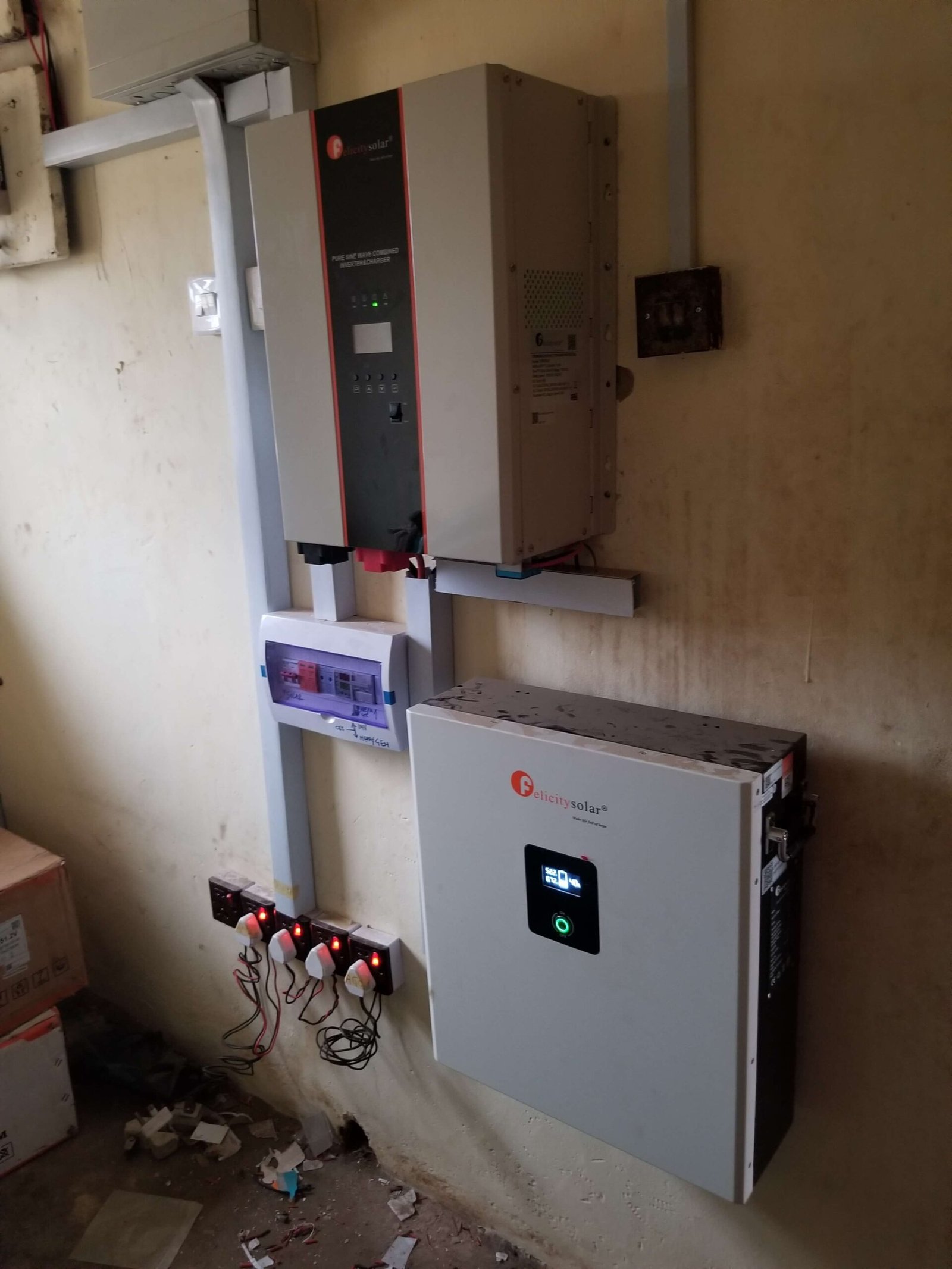
Before you buy a single panel, inverter or battery, there is one exercise that decides whether your solar system will serve you well or disappoint you: calculating your load. A solar load calculator is simply a structured way of answering three questions:
- How big must my inverter be?
- How much battery storage do I need?
- How many solar panels do I need?
You do not need engineering training to do this. With a pen, a calculator and a list of your appliances, you can get a solid estimate in about fifteen minutes. This guide walks you through every step with formulas, a worked example and a template you can copy.
At PA DigiTech Solar, this is exactly where we start with every customer, before any equipment is recommended. If you would rather have us check your figures, call 07068853073.
Why Calculate Your Load First?
Most solar disappointments in Nigeria trace back to skipping this step:
- A system that is too small shuts down when you switch on the pump or AC.
- A system that is too big means you have paid for capacity you never use.
- A system with mismatched parts (big inverter, small batteries, few panels) never performs as promised.
A few minutes of calculation protects a significant investment.
Three Terms You Need to Know
| Term | Unit | Meaning |
|---|---|---|
| Power | Watts (W) | How much electricity an appliance draws at any moment. Sets the inverter size. |
| Energy | Watt-hours (Wh) or kilowatt-hours (kWh) | Power multiplied by time. Sets battery and panel size. 1 kWh = 1,000 Wh. |
| Surge (start-up) power | Watts (W) | The brief spike when motors and compressors start. Affects inverter choice. |
An easy way to picture it: power is how fast water flows from a tap, energy is how much water fills the bucket over the day.
Step 1: List Every Appliance You Want Solar to Run
Walk through your home or shop and write down every appliance you want on the solar system. Be honest here. Leaving something out is the most common source of error.
Find each appliance’s power rating on its label, usually on the back, underside or in the manual. If it shows volts and amps instead of watts, multiply them:
Watts = Volts × Amps
Typical Appliance Wattages (Approximate Guide)
These are rough ranges to help you estimate. Always check your own appliance label, because models and efficiency differ.
| Appliance | Typical running power |
|---|---|
| LED bulb | 5 to 15 W |
| Ceiling fan | 50 to 80 W |
| Standing or table fan | 40 to 100 W |
| LED television (32 to 55 inch) | 40 to 150 W |
| Refrigerator (medium) | 100 to 200 W |
| Chest or upright freezer | 150 to 300 W |
| Laptop | 45 to 90 W |
| Desktop computer and monitor | 150 to 300 W |
| Wi-Fi router | 10 to 20 W |
| Phone charger | 5 to 20 W |
| CCTV system (DVR and cameras) | 30 to 100 W |
| Water pump (0.5 to 1 HP) | 400 to 800 W |
| Washing machine | 400 to 800 W |
| Microwave oven | 800 to 1,200 W |
| Air conditioner (1 HP split) | 700 to 1,000 W |
| Air conditioner (1.5 HP split) | 1,000 to 1,500 W |
| Iron | 1,000 to 1,200 W |
| Electric kettle | 1,500 to 2,000 W |
| Electric cooker or oven | 2,000 W and above |
Heating appliances (irons, kettles, cookers, water heaters) are the most demanding on a solar system. Many households leave them off the solar circuit.
Step 2: Calculate Daily Energy Use
For each appliance:
Daily energy (Wh) = Power (W) × Quantity × Hours used per day
Add up the results to get your total daily energy in Wh. Divide by 1,000 for kWh.
A note on refrigerators and freezers. They do not draw full power around the clock because the compressor cycles on and off. A common approach is to estimate the hours the compressor actually runs (often around 8 to 12 hours out of 24) rather than using 24. Your installer can refine this.
Step 3: Find Your Peak Load
Peak load is the total power of everything that might run at the same time.
Peak load (W) = Sum of the watts of appliances running together
Be realistic about what runs at once. If you never run the pump, iron and microwave together, you do not need to size for all three at once. But if you might, include them.
A Worked Example
The figures below are illustrative and show the method. Your own appliances will differ.
| Appliance | Qty | Watts each | Total W | Hours/day | Daily Wh |
|---|---|---|---|---|---|
| LED bulbs | 10 | 10 | 100 | 6 | 600 |
| Ceiling fans | 4 | 60 | 240 | 8 | 1,920 |
| Television | 1 | 100 | 100 | 5 | 500 |
| Refrigerator | 1 | 150 | 150 | 10 | 1,500 |
| Freezer | 1 | 200 | 200 | 10 | 2,000 |
| Wi-Fi router | 1 | 15 | 15 | 24 | 360 |
| Laptops | 2 | 65 | 130 | 6 | 780 |
| Water pump (1 HP) | 1 | 750 | 750 | 1 | 750 |
| Total | 1,685 W | 8,410 Wh (about 8.4 kWh) |
So in this example:
- Peak load (if everything ran at once): about 1,685 W
- Daily energy: about 8,410 Wh
Step 4: Calculate the Inverter Size
Inverters are usually rated in kVA (apparent power). Appliances use watts (real power). The link between them is the power factor, commonly taken as around 0.8 for a simple estimate:
Inverter size (VA) = (Peak load in W ÷ 0.8) × 1.25
The ×1.25 adds roughly 25 percent headroom so the inverter does not run at its limit, and leaves room for small additions later.
Applying it to the example:
- 1,685 ÷ 0.8 = about 2,106 VA
- 2,106 × 1.25 = about 2,633 VA
Now check the surge. Pumps, refrigerators and freezers draw much more briefly when starting. A 750 W pump might demand roughly two to three times its running power for a moment. The inverter must be able to handle that surge, so check its surge rating as well as its continuous rating.
Result for this example: around 3 kVA at minimum. A 5 kVA unit would give comfortable surge headroom and room for growth, such as adding a second freezer or an air conditioner later.
Some modern inverters are rated directly in kW. If so, compare your peak load in watts to the inverter’s continuous kW rating, plus its surge rating.
Step 5: Calculate Battery Capacity
First, decide how much energy you need from batteries, which is the energy used when the panels are not producing, mainly in the evening and at night. Add up the Wh of the appliances you want to power after sunset and through the night.
Then allow for two real-world factors:
- Depth of discharge (DoD): how much of a battery’s rated capacity you can safely use. Lithium batteries commonly allow a high share (often around 80 to 90 percent), while tubular lead-acid batteries are usually limited to around 50 percent for a long life.
- System efficiency: some energy is lost in conversion. Around 90 percent is a common working figure.
Battery capacity needed (Wh) = Night energy (Wh) ÷ DoD ÷ Efficiency
Applying it to the example. Suppose about 5,000 Wh of the 8,410 Wh is used after sunset (lights, fans, TV, router and a share of the fridge and freezer).
| Battery type | Calculation | Capacity needed |
|---|---|---|
| Lithium (90% DoD) | 5,000 ÷ 0.9 ÷ 0.9 | about 6,170 Wh (6.2 kWh) |
| Tubular lead-acid (50% DoD) | 5,000 ÷ 0.5 ÷ 0.9 | about 11,100 Wh (11.1 kWh) |
Converting to amp-hours (Ah):
Ah = Wh ÷ System voltage
At a 48 V system:
- Lithium: 6,170 ÷ 48 = about 130 Ah
- Tubular: 11,100 ÷ 48 = about 230 Ah, which could be four 12 V 230 Ah batteries connected in series to make 48 V
Notice how much more rated capacity the lead-acid option needs for the same usable energy. That is one reason people compare lithium and tubular on lifespan and total cost rather than the purchase price alone.
System voltage guide (rough rule): smaller inverters (around 1 to 1.5 kVA) often use 12 V, mid-sized ones (around 2 to 3 kVA) often use 24 V, and larger ones (5 kVA and above) commonly use 48 V. Always follow the specification of the inverter you choose.
Step 6: Calculate the Number of Solar Panels
Panels must generate your daily energy, allowing for the sunlight available and for system losses.
Panel capacity (W) = Daily energy (Wh) ÷ (Peak sun hours × System efficiency)
Peak sun hours is the number of hours per day at full-strength sunlight equivalent. Across much of Nigeria it is commonly estimated at roughly 4 to 6, varying by region and season. Using a conservative figure protects you in cloudy periods. A typical system efficiency factor is around 0.75 once losses from wiring, heat, dust and conversion are included.
Applying it to the example (using 4.5 peak sun hours and 0.75 efficiency):
- 4.5 × 0.75 = 3.375
- 8,410 ÷ 3.375 = about 2,490 W, so roughly 2.5 kW of panels
Number of panels:
Panels = Total panel capacity ÷ Wattage of one panel
| Panel size | Calculation | Number needed |
|---|---|---|
| 400 W | 2,490 ÷ 400 = 6.2 | 7 panels |
| 550 W | 2,490 ÷ 550 = 4.5 | 5 panels |
Always round up. Also confirm that your inverter’s solar input (charge controller) can accept the array size you plan.
The Full Example at a Glance
| Component | Result for the example household |
|---|---|
| Peak load | about 1,685 W |
| Daily energy | about 8.4 kWh |
| Inverter | around 3 kVA minimum, 5 kVA for surge headroom and growth |
| Battery (lithium) | about 6.2 kWh, roughly 130 Ah at 48 V |
| Battery (tubular) | about 11.1 kWh, roughly 230 Ah at 48 V |
| Solar panels | about 2.5 kW, such as 5 × 550 W or 7 × 400 W |
This is an illustration of the method, not a recommendation for your home.
Your Blank Calculation Template
Copy this table and fill it in for your own home or business.
| Appliance | Qty | Watts each | Total W | Hours/day | Daily Wh |
|---|---|---|---|---|---|
| Totals | Peak W | Daily Wh |
Then apply:
- Inverter (VA) = (Peak W ÷ 0.8) × 1.25, checked against surge needs
- Battery (Wh) = Night energy ÷ DoD ÷ 0.9
- Panels (W) = Daily Wh ÷ (Peak sun hours × 0.75)
What Changes the Numbers
Your result will move depending on:
- Air conditioners. One unit can use more energy in a night than all your essentials combined.
- Backup hours. More backup means more battery.
- Rainy season. Cloudy days reduce generation, so many designs add panel or battery margin, or keep the grid or a generator as a backup.
- Shading and panel angle. Trees, walls and water tanks cut output.
- Heat and dust. Both reduce efficiency.
- Future appliances. Planning for growth now is cheaper than rebuilding later.
Common Calculation Mistakes
- Using hours the appliance is plugged in instead of hours it actually draws power. This overstates refrigerators and freezers.
- Ignoring surge power. A pump or freezer that runs fine on the grid can trip an undersized inverter.
- Forgetting depth of discharge. A 100 Ah battery does not give you 100 Ah of usable energy.
- Skipping system losses. Using 100 percent efficiency makes everything look smaller than it will be in practice.
- Using optimistic sunlight figures. Be conservative, especially for rainy-season reliability.
- Copying a neighbour’s system. Their load is not your load.
- Leaving out future appliances. Mention planned additions during assessment.
Can an Online Calculator Replace a Professional Assessment?
A calculator, including the method in this guide, is an excellent way to understand your needs and prepare for a conversation. But a real design also considers things a formula cannot see:
- The condition and direction of your roof
- Shading across the day and year
- The inverter’s actual surge and solar input limits
- Battery compatibility and how the system will be expanded
- Cable sizes, protection devices and earthing
- Placement, ventilation and safety
Treat your calculation as a strong starting point, then have an installer verify and refine it.
Let PA DigiTech Solar Check Your Numbers
At PA DigiTech Solar, we design and install solar panels, inverters and battery systems for homes and businesses across Nigeria. We begin with your actual appliances and usage, so the system we recommend matches how you live or run your business.
Bring your completed table, or just a list of appliances, and we will help you turn it into a properly sized system. Call PA DigiTech Solar on 07068853073 to discuss your requirements.
Frequently Asked Questions
How do I calculate my solar load in Nigeria?
List your appliances and their wattages, multiply by hours of daily use to get energy in watt-hours, and add up the wattages of what runs together to find your peak load. Those two figures drive the inverter, battery and panel sizing.
How do I calculate the inverter size I need?
A simple estimate is (peak load in watts ÷ 0.8) × 1.25, then check the inverter’s surge rating against your pumps, freezers and air conditioners.
How do I calculate battery capacity for solar?
Divide the energy you need at night by the battery’s depth of discharge and by system efficiency, then divide by system voltage to get amp-hours.
How many solar panels do I need?
Divide your daily energy by peak sun hours multiplied by system efficiency to get the panel capacity, then divide by the wattage of one panel.
How many batteries do I need for a 5kVA inverter?
It depends on your backup hours and the battery type, not just the inverter. A 5kVA system usually runs at 48 V, and the battery capacity is worked out from your night energy use.
What is the difference between kVA and kW?
kVA is apparent power and kW is real power. They are linked by the power factor, often taken as about 0.8 for a quick estimate, so a 5kVA inverter is roughly 4kW at that factor. Always check the inverter’s own specification.
Why is lithium different from tubular in the calculation?
Lithium batteries typically allow a deeper usable discharge, so less rated capacity is needed to deliver the same usable energy.
Does a calculator account for the rainy season?
Only if you build it in. Use conservative sunlight figures and consider extra panel or battery margin, or a grid or generator backup, for cloudy periods.
Can I include an air conditioner in the calculation?
Yes. Add its wattage and daily hours like any other appliance, and remember it has a start-up surge. Air conditioners often dominate the total.
How accurate is a DIY solar load calculation?
It gives a sound estimate for planning. A professional assessment refines it with site conditions, surge limits, protection and compatibility.
What if I do not know my appliance wattages?
Check the labels, use the typical ranges in this guide as a rough start, and let an installer confirm them.
How do I get a solar quotation after calculating my load?
Share your appliance list and backup requirements with an installer. Call PA DigiTech Solar on 07068853073 to discuss your needs.
Conclusion
A solar load calculation turns guesswork into a plan. List your appliances, find your peak load and daily energy, then work through the inverter, battery and panel formulas. Be honest about what you want to run, be conservative with sunlight and losses, and have a professional verify the result before you buy.
Do that, and you will buy the system your home or business actually needs.
Ready to size your system properly? Call PA DigiTech Solar on 07068853073.