
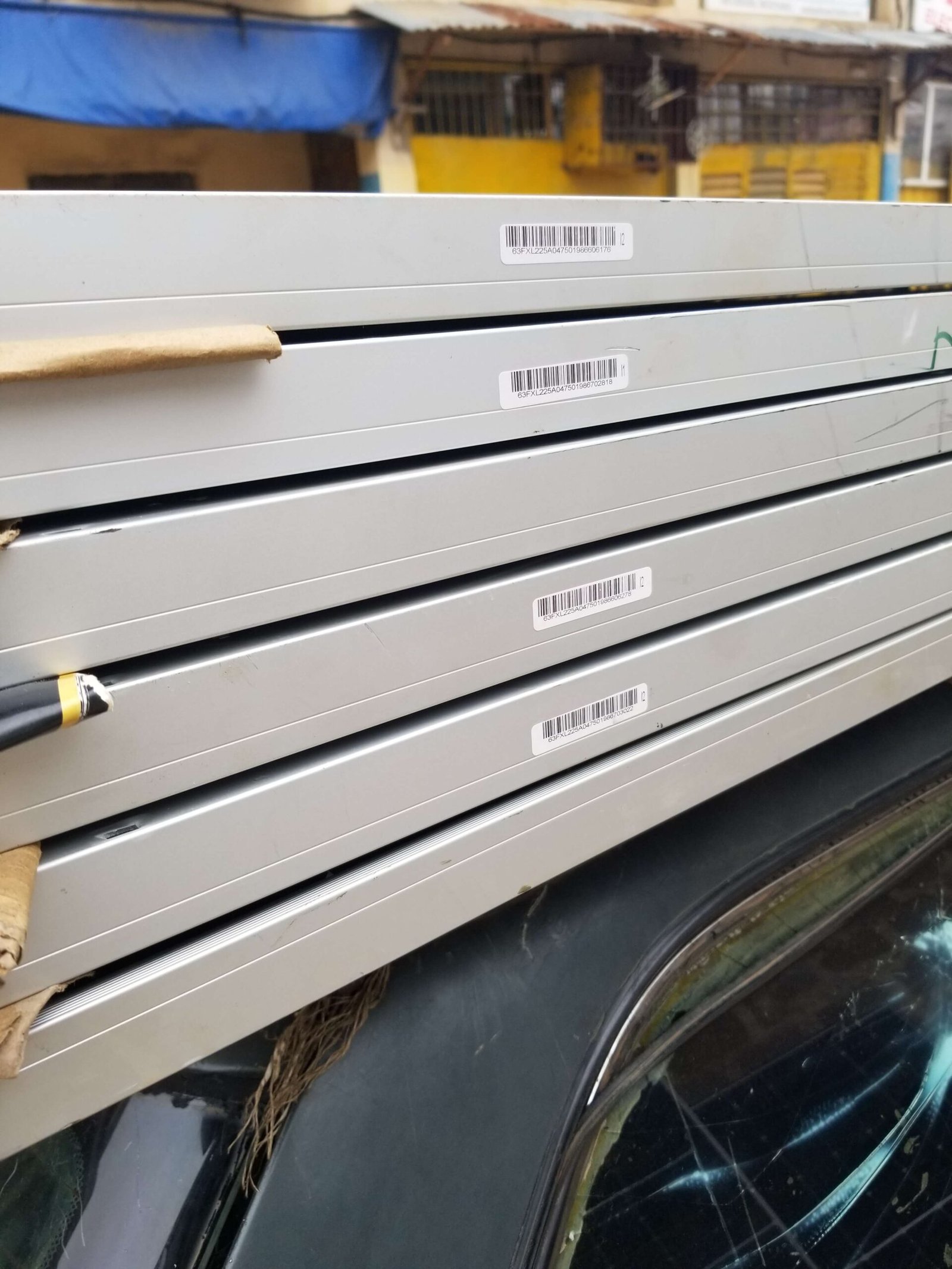
If you are planning to install solar power in your home or business, one of the first things you will probably want to know is the solar panel price in Nigeria.
Solar panel prices have changed significantly over the years as higher-wattage panels have become more common. Today, 450W, 550W, 600W and 650W panels are widely considered for residential and commercial solar installations because they can provide more generating capacity with fewer individual panels.
In Nigeria, the price of a solar panel depends on several factors, including its wattage, brand, cell technology, efficiency, physical size, availability and where you purchase it.
As of 2026, current Nigerian market sources show 450W panels around ₦95,000 to ₦210,000, 550W panels around ₦115,000 to ₦265,000, 600W panels around ₦110,000 to ₦295,000, and 650W-class panels around ₦120,000 to ₦250,000+, depending heavily on the exact model and seller.
This guide explains current solar panel prices in Nigeria, the cost of different panel wattages, popular panel technologies, how many panels you may need and what to check before buying.
Important: The prices in this article are indicative 2026 market estimates for the solar panel itself. They do not automatically include the inverter, batteries, mounting structures, cables, protection equipment, transportation or installation labour. Prices can change because of exchange rates, stock availability, brand, location and supplier pricing.
How Much Is a Solar Panel in Nigeria in 2026?
There is no single price for a solar panel in Nigeria because panels are available in many different wattages and specifications.
For the higher-wattage panels commonly considered for modern solar installations, a useful 2026 market guide is:
| Solar Panel | Approximate 2026 Price |
|---|---|
| 400W | ₦90,000 – ₦185,000 |
| 450W | ₦95,000 – ₦210,000 |
| 500W | ₦100,000 – ₦240,000 |
| 550W | ₦115,000 – ₦265,000 |
| 580W | ₦139,000 – ₦150,000 |
| 600W | ₦110,000 – ₦295,000 |
| 620W | ₦155,000 – ₦190,000 |
| 650W | ₦120,000 – ₦250,000+ |
| 680W – 700W | ₦120,000 – ₦250,000+ |
These ranges demonstrate an important point: higher wattage does not always mean a higher purchase price.
For example, current Nigerian listings show some 600W panels around ₦110,000 to ₦120,000, while certain 550W panels are listed around ₦149,000 to ₦160,000. The exact brand, technology and supplier make a significant difference.
450W Solar Panel Price in Nigeria
The 450W solar panel price in Nigeria currently falls broadly between:
₦95,000 and ₦210,000 per panel
Some current Nigerian listings are considerably lower than the upper end of this range. For example, one September 2026 market listing shows a Jinko 450W monocrystalline panel at about ₦82,969, while another listing shows a LONGi 450W all-black panel at ₦115,000.
Marketplace listings also show 450W panels around ₦87,250 to ₦95,000, demonstrating how much prices can vary between sellers.
450W panels can be useful for residential installations where roof space, panel dimensions and system voltage need to be considered.
For example, ten 450W panels provide a combined nameplate capacity of:
10 × 450W = 4,500W or 4.5kW
That does not mean the array will produce exactly 4.5kW continuously. Actual output changes throughout the day according to sunlight, temperature, shading, panel orientation and system losses.
550W Solar Panel Price in Nigeria
The 550W solar panel price in Nigeria can currently range from approximately:
₦115,000 to ₦265,000 per panel
This is one of the most popular panel categories for larger residential and commercial solar installations.
Current Nigerian market listings show significant variation. Solar equipment listings include JA Solar 550W panels around ₦149,000 to ₦160,000 and a LONGi 550W panel listed at approximately ₦95,000.
Other 2026 market estimates put 550W panels within a wider range of approximately ₦115,000 to ₦265,000 depending on the brand and model.
A 550W panel is attractive because fewer panels can be used to build a relatively large solar array.
For example:
6 × 550W = 3.3kW
8 × 550W = 4.4kW
10 × 550W = 5.5kW
The final number of panels should still be determined by the inverter specifications and overall solar system design.
600W Solar Panel Price in Nigeria
A 600W solar panel can cost approximately:
₦110,000 to ₦295,000
The wide range reflects differences between panel manufacturers and technologies.
For example, current September 2026 listings include 600W Jinko bifacial panels around ₦110,000 to ₦120,000, while a LONGi 600W all-black panel is listed around ₦110,000. Other market estimates place some 600W panels significantly higher.
A 600W panel provides 0.6kW of rated capacity.
Therefore:
5 × 600W = 3kW
8 × 600W = 4.8kW
10 × 600W = 6kW
Again, these are the panels’ combined rated capacities, not guaranteed real-world output at every moment.
650W Solar Panel Price in Nigeria
The 650W solar panel price in Nigeria can currently fall roughly between:
₦120,000 and ₦250,000+
Some current Nigerian listings are considerably more competitive. For example, SolarBuilders’ September 2026 listings show Jinko 650W to 700W bifacial panels at about ₦120,000 and JA Solar 650W to 700W bifacial panels around ₦120,000 to ₦125,000.
Jumia’s current Nigerian marketplace listings also show 650W-class panels, although marketplace prices vary considerably between sellers and products.
650W panels can be particularly useful for larger solar arrays because they allow higher installed capacity with fewer modules.
For example:
6 × 650W = 3.9kW
8 × 650W = 5.2kW
10 × 650W = 6.5kW
However, the inverter must be able to accept the resulting solar-array voltage, current and power.
450W vs 550W vs 600W vs 650W Solar Panels
If you are choosing between these four panel sizes, it is useful to compare more than the price of one panel.
| Panel | Rated Power | 8 Panels | 10 Panels |
|---|---|---|---|
| 450W | 450W | 3.6kW | 4.5kW |
| 550W | 550W | 4.4kW | 5.5kW |
| 600W | 600W | 4.8kW | 6.0kW |
| 650W | 650W | 5.2kW | 6.5kW |
The higher-wattage panels can provide more total nameplate capacity with fewer modules.
However, that does not automatically make them the best choice for every property.
The panel must fit the available roof or mounting area, and its electrical specifications must match the inverter.
Is a 650W Solar Panel Better Than a 450W Panel?
Not necessarily.
A 650W panel has a higher rated power output, but that does not automatically mean it is the better choice.
The correct panel depends on the complete system design.
You should consider:
- Available roof space
- Panel dimensions
- Panel weight
- Inverter specifications
- MPPT voltage range
- Maximum PV current
- Required solar capacity
- Panel efficiency
- Price per watt
- Brand and warranty
- Availability of replacement panels
A 450W panel can be the more practical option for one installation, while a 650W panel may be more appropriate for another.
Why Are Some 550W Panels More Expensive Than 650W Panels?
This is a common question when comparing solar panel prices.
It may seem logical that a 650W panel should always cost more than a 550W panel.
However, solar panel pricing is not determined by wattage alone.
A premium 550W panel from an established manufacturer may cost more than a lower-priced 650W panel from another manufacturer.
Differences can include:
- Cell technology
- Efficiency
- Bifacial capability
- Manufacturing quality
- Warranty
- Product availability
- Brand reputation
- Physical construction
- Supplier margins
For example, current Nigerian listings show 550W JA Solar panels around ₦149,000 to ₦160,000 while some 650W to 700W panels are listed around ₦120,000 to ₦125,000.
This is why comparing price per watt can sometimes be more useful than comparing the price of individual panels.
Solar Panel Price Per Watt
Price per watt provides another way to compare panels.
For example, suppose a 550W panel costs ₦150,000.
The approximate price per watt is:
₦150,000 ÷ 550W = ₦273 per watt
Now consider a 650W panel costing ₦125,000:
₦125,000 ÷ 650W = ₦192 per watt
The 650W panel has a lower purchase price per watt in this example.
However, price per watt should not be the only consideration because the panel’s efficiency, physical dimensions, warranty and electrical specifications also matter.
Monocrystalline Solar Panel Price in Nigeria
Monocrystalline panels are widely used in modern residential and commercial installations.
They are commonly available in higher wattages such as 400W, 450W, 500W, 550W, 600W and 650W.
Current Nigerian listings include monocrystalline products from manufacturers such as Jinko, LONGi, JA Solar, Trina Solar and Canadian Solar.
The price depends on the exact panel technology and model.
Bifacial Solar Panel Price in Nigeria
Bifacial solar panels are designed to generate electricity from light reaching both sides of the module under suitable installation conditions.
They are increasingly available in higher wattages.
Current Nigerian listings include 600W Jinko bifacial panels around ₦110,000 to ₦120,000 and 650W to 700W bifacial panels from Jinko and JA Solar around ₦120,000 to ₦125,000 in some listings.
The potential advantage of bifacial technology depends heavily on the installation environment.
The rear side needs suitable access to reflected or additional light for the technology to provide meaningful extra generation.
N-Type Solar Panel Price in Nigeria
N-Type technology is another development found in newer solar panels.
The term refers to the type of semiconductor wafer used in the solar cell, and N-Type products can offer high efficiency and other performance characteristics depending on the specific technology.
Current Nigerian listings include N-Type panels such as 600W Jinko products.
When comparing an N-Type panel with an older panel technology, look at the complete datasheet rather than relying only on the “N-Type” label.
Popular Solar Panel Brands in Nigeria
Several manufacturers are commonly encountered in the Nigerian solar market.
These include:
- Jinko Solar
- LONGi Solar
- JA Solar
- Trina Solar
- Canadian Solar
Current Nigerian supplier listings show products from these manufacturers across 450W, 550W, 580W, 600W and 650W-class categories.
Different brands have different product ranges, so the exact model number is more useful than simply knowing the brand.
How Many 450W Solar Panels Do I Need?
The number of 450W panels required depends on the total solar capacity you want.
For example:
4 panels = 1.8kW
6 panels = 2.7kW
8 panels = 3.6kW
10 panels = 4.5kW
12 panels = 5.4kW
However, these calculations only describe the panel array’s rated capacity.
The actual number required for a complete solar system also depends on your daily energy consumption, battery capacity, inverter specifications and available solar resource.
How Many 550W Solar Panels Do I Need?
For 550W panels:
4 panels = 2.2kW
6 panels = 3.3kW
8 panels = 4.4kW
10 panels = 5.5kW
12 panels = 6.6kW
The inverter’s maximum PV input must be checked before deciding on the final configuration.
How Many 600W Solar Panels Do I Need?
With 600W panels:
4 panels = 2.4kW
6 panels = 3.6kW
8 panels = 4.8kW
10 panels = 6kW
12 panels = 7.2kW
The actual configuration may involve connecting panels in series, parallel or a combination of both depending on the inverter.
How Many 650W Solar Panels Do I Need?
With 650W panels:
4 panels = 2.6kW
6 panels = 3.9kW
8 panels = 5.2kW
10 panels = 6.5kW
12 panels = 7.8kW
Again, the inverter’s maximum PV voltage, current and power limits must be checked before connecting the array.
Can I Mix 450W and 550W Solar Panels?
It is technically possible in some system designs, but it should not be done casually.
Panels connected in the same string should have suitable electrical characteristics.
Mixing panels with significantly different voltage and current characteristics can affect the performance of the array.
If you are expanding an existing solar system, it is usually better to assess the existing panels and inverter first before adding different modules.
Can I Mix 550W and 650W Solar Panels?
The same principle applies.
Different panel wattages do not automatically mean they can be connected together in the same string.
The voltage, current and electrical characteristics of the modules must be considered.
The inverter’s MPPT configuration also matters.
If you are upgrading an existing installation, professional assessment can help determine whether the new panels can be integrated properly.
Solar Panel Voltage and Current Matter
Wattage is only one specification.
When purchasing a solar panel, you should also check:
Voc: Open-circuit voltage.
Vmp: Voltage at maximum power.
Isc: Short-circuit current.
Imp: Current at maximum power.
These specifications are important when designing the panel strings.
For example, a panel may be advertised as 650W, but its voltage and current still need to fall within the operating limits of the inverter or charge controller.
Solar Panel Efficiency
Efficiency describes how effectively the panel converts available sunlight into electrical energy.
A higher-efficiency panel can produce more power from a given area under comparable conditions.
This can be particularly useful where roof space is limited.
However, efficiency should not be considered in isolation.
A lower-cost panel with slightly different efficiency may still provide good value if it has suitable specifications, quality and warranty support.
Solar Panel Size and Roof Space
High-wattage panels can also be physically larger.
This matters when planning a rooftop installation.
Before purchasing 600W or 650W panels, check:
- Roof dimensions
- Panel dimensions
- Panel weight
- Available mounting area
- Roof structure
- Shading
- Access for installation
- Required maintenance space
The objective is not simply to purchase the highest-wattage panel available.
The panels must physically and electrically fit the solar system.
How Much Do Solar Panels Cost for a 5kW Solar System?
A 5kW solar array can be built using different panel combinations.
For example:
10 × 500W = 5kW
10 × 550W = 5.5kW
8 × 600W = 4.8kW
8 × 650W = 5.2kW
Using a rough 2026 panel price range, the cost of the panels alone can vary substantially depending on which configuration and brand is selected.
For example, 10 panels priced at ₦150,000 each would cost:
₦1,500,000
But this is only the panel cost.
It does not include the inverter, batteries, mounting, wiring, protection equipment or installation.
How Much Do Solar Panels Cost for a 10kW Solar System?
A 10kW solar array could use:
20 × 500W panels
18 × 550W panels = 9.9kW
17 × 600W panels = 10.2kW
16 × 650W panels = 10.4kW
The final number and configuration depend on the selected inverter and the property’s energy requirements.
A 10kW array also requires sufficient roof or ground space and an inverter capable of accepting the proposed PV input.
Solar Panel Cost vs Complete Solar System Cost
One of the most important things to understand is that the price of the panels is only one part of a solar installation.
A complete system may also require:
- Solar inverter
- Batteries
- Panel mounting structures
- DC cables
- AC cables
- MC4 connectors
- DC breakers
- AC breakers
- Surge protection
- Earthing
- Distribution equipment
- Installation labour
- Testing and commissioning
Therefore, if ten 550W panels cost ₦1.5 million, you should not assume that a complete 5.5kW solar installation will cost ₦1.5 million.
The other components can represent a substantial part of the total project cost.
What Makes Solar Panels Expensive?
Several factors can increase the price of a solar panel.
Brand
Established manufacturers may charge more for their products.
Cell Technology
N-Type, TOPCon, HJT, bifacial and other technologies can have different manufacturing costs and performance characteristics.
Efficiency
Higher-efficiency products can command a premium, especially where space is limited.
Wattage
Higher-wattage panels can cost more, although this is not always the case.
Warranty
Product and performance warranties can influence the price.
Availability
A panel that is scarce in the Nigerian market may cost more than a readily available alternative.
Exchange Rate
Many solar products are imported, meaning exchange-rate movements can affect local pricing.
Quantity
Bulk purchases may receive different pricing from retail purchases.
How to Choose the Right Solar Panel in Nigeria
The cheapest panel is not necessarily the best choice.
Before purchasing, compare the complete specifications.
Look at:
Wattage: How much rated power does the panel provide?
Efficiency: How effectively does it convert sunlight?
Voc and Vmp: Are the voltage characteristics suitable?
Isc and Imp: Are the current characteristics compatible?
Dimensions: Will it fit your available space?
Weight: Can the roof or mounting structure support it?
Technology: Is it conventional mono, N-Type, bifacial or another technology?
Warranty: What product and performance warranties are offered?
Manufacturer: Is the brand established and traceable?
Authenticity: Can the panel’s specifications and serial number be verified?
Should You Buy 450W, 550W, 600W or 650W Panels?
There is no single wattage that is best for every installation.
A 450W panel may be appropriate where the physical dimensions or electrical characteristics fit the system.
A 550W panel can provide a useful balance between panel count and capacity.
A 600W or 650W panel may be attractive for larger systems where fewer modules are preferred.
The correct choice depends on the complete system design.
At PA DigiTech Solar, we can assess the inverter, battery, available installation space and energy requirements before determining the appropriate panel configuration.
Where to Buy Solar Panels in Nigeria
Solar panels are available through specialist solar equipment suppliers, electrical suppliers and online marketplaces.
Current Nigerian listings show considerable differences between sellers, even for panels with similar wattages.
When buying a significant number of panels, it is advisable to confirm the exact model, specifications, warranty and authenticity before making payment.
For a complete solar installation, purchasing panels as part of a professionally designed system can also reduce the risk of choosing panels that are incompatible with the inverter.
Why Professional Solar Panel Installation Matters
Solar panels may appear simple to install, but the complete array needs to be designed correctly.
The installer needs to consider:
- Panel orientation
- Shading
- Mounting structure
- Roof condition
- String configuration
- Cable sizing
- PV voltage
- PV current
- Inverter limitations
- Earthing
- Surge protection
- Accessibility
Incorrect configuration can reduce system performance or create electrical problems.
Professional installation therefore involves considerably more than placing panels on a roof and connecting cables.
Get Solar Panel Installation in Nigeria
If you are planning to buy solar panels for your home or business, the panel price should be considered as part of the complete solar system rather than as an isolated purchase.
At PA DigiTech Solar, we provide solar panel installation, solar inverter installation, battery installation and complete solar system design for residential and commercial properties.
We can help determine the appropriate panel capacity based on your electricity requirements, inverter specifications, available installation space and desired system performance.
Our services are available across Nigeria, including Lagos, Abuja, Ibadan, Port Harcourt, Kano and other locations.
For solar panel installation enquiries and system consultations, contact PA DigiTech Solar on 07068853073.
Frequently Asked Questions About Solar Panel Prices in Nigeria
How much is a 450W solar panel in Nigeria in 2026?
A 450W panel can cost approximately ₦95,000 to ₦210,000, although current listings show some models below this broad range. The exact price depends on the manufacturer, technology and seller.
How much is a 550W solar panel in Nigeria?
A 550W panel can cost approximately ₦115,000 to ₦265,000. Current listings show some branded models around ₦149,000 to ₦160,000 and others at different prices.
How much is a 600W solar panel in Nigeria?
A 600W panel can range from approximately ₦110,000 to ₦295,000, depending on brand and technology. Some current listings are available around ₦110,000 to ₦120,000.
How much is a 650W solar panel in Nigeria?
A 650W panel can cost approximately ₦120,000 to ₦250,000+. Current listings for 650W to 700W bifacial panels from some established manufacturers are around ₦120,000 to ₦125,000.
Is a 650W panel better than a 550W panel?
Not necessarily. A 650W panel has a higher rated output, but the better option depends on your inverter, roof space, panel dimensions, electrical specifications, price and overall system design.
How many 550W panels do I need for a 5kVA inverter?
There is no universal number. The appropriate number depends on the inverter’s maximum PV power, voltage and current limits, battery requirements and the amount of energy you want the system to generate.
How many 650W panels do I need for a 10kW solar system?
A simple nameplate calculation would be around 16 panels:
16 × 650W = 10.4kW
However, the actual configuration must be checked against the inverter’s PV voltage, current and maximum input-power specifications.
Can I use 650W solar panels with a 5kVA inverter?
Possibly, but it depends on the inverter. The panel’s voltage, current and total PV capacity must fall within the inverter’s specifications.
Are monocrystalline solar panels better?
Monocrystalline panels are widely used because they can offer high efficiency and good power density, but the exact product specifications matter more than the general label.
What is the difference between 450W and 650W solar panels?
The main difference is their rated power output. A 650W panel can provide a higher rated output than a 450W panel under standard test conditions. It may therefore allow a larger solar array using fewer panels, although physical dimensions and electrical specifications also need to be considered.
Does a solar panel produce its rated wattage all day?
No. The wattage printed on the panel represents its rated output under standard test conditions. Real-world output varies according to sunlight intensity, temperature, shading, orientation, dirt and system losses.
Final Thoughts on Solar Panel Price in Nigeria
The solar panel price in Nigeria in 2026 varies significantly depending on wattage, brand, technology, efficiency and supplier.
For the panel sizes most relevant to modern residential and commercial installations, a useful budgeting guide is:
- 450W: approximately ₦95,000 – ₦210,000
- 550W: approximately ₦115,000 – ₦265,000
- 600W: approximately ₦110,000 – ₦295,000
- 650W: approximately ₦120,000 – ₦250,000+
Current listings demonstrate that actual prices can fall outside these broad ranges, particularly when comparing different brands and technologies.
When buying solar panels, do not look at wattage and price alone. Check the panel’s efficiency, Voc, Vmp, Isc, Imp, dimensions, weight, technology, warranty and compatibility with your inverter.
Most importantly, the right panel should be selected as part of a complete solar system design.
If you need help determining the appropriate solar panels for your home or business, PA DigiTech Solar can assess your requirements and design the appropriate system. Call 07068853073 for enquiries and solar installation services.