
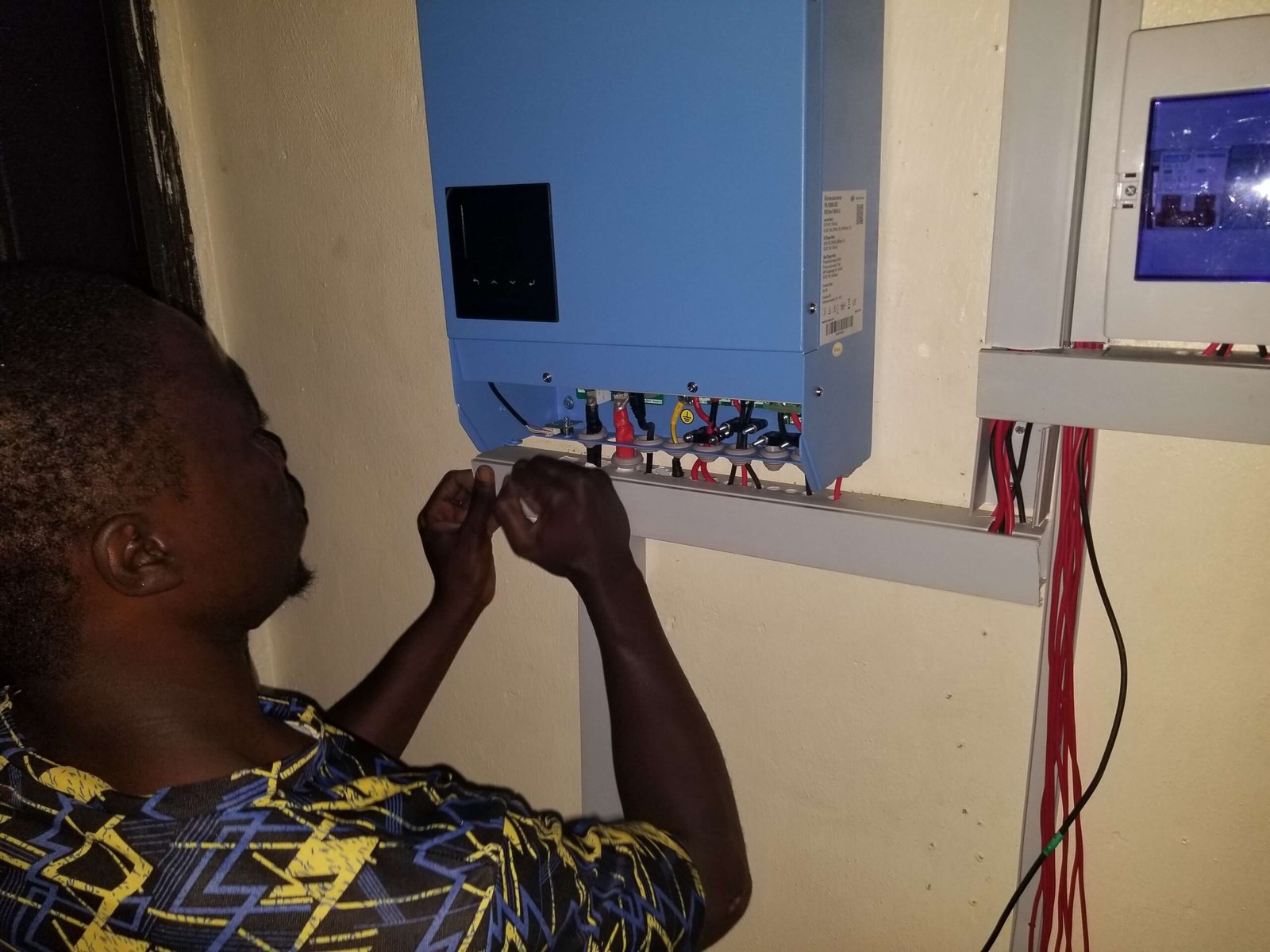
A reliable solar power system starts with proper design. Installing solar panels, an inverter and batteries without first determining the property’s actual energy requirements can result in poor performance, insufficient backup, unnecessary costs or equipment that does not work well together.
At PA DigiTech Solar, we provide professional solar system design and installation services in Nigeria for homes, offices, shops, schools, churches, hotels, farms and other properties. Our approach begins with understanding how much electricity you use, what you want the system to power and how much backup you need before selecting and installing the appropriate equipment.
Whether you need a small solar system for essential appliances or a larger solution designed to support air conditioners, refrigeration equipment, office equipment and other heavy loads, proper system design helps ensure that the final installation matches your requirements.
What Is Solar System Design?
Solar system design is the process of determining the appropriate components, capacities and configuration required to build a functional solar power system for a particular property.
A properly designed system considers much more than the size of the inverter. It brings together several factors, including:
The appliances and electrical loads in the property
Daily electricity consumption
Peak power demand
Required battery backup duration
Available sunlight
Solar panel capacity
Inverter capacity
Battery capacity
Charging requirements
Available roof or ground space
Future electricity requirements
Budget and installation conditions
The objective is to create a system in which the solar panels, inverter, batteries and electrical loads work together correctly.
This is why two houses of similar size may require completely different solar systems.
Why Proper Solar System Design Matters in Nigeria
Solar equipment is a significant investment, so choosing components based only on their advertised capacity can be costly.
For example, someone may decide to purchase a 5kVA inverter because they have a four-bedroom house. However, the number of bedrooms does not determine the actual electrical load. One household may primarily power lights, fans, televisions and refrigerators, while another may operate multiple air conditioners, freezers, pumps and other high-power appliances.
A proper design looks at the actual requirements instead of making assumptions.
Good solar system design can help you:
Select the appropriate inverter capacity
Determine the required number of solar panels
Calculate suitable battery storage
Avoid unnecessary equipment
Reduce the risk of overloading
Improve battery performance
Make better use of available solar energy
Plan for future expansion
Achieve the required backup duration
The design stage therefore has a direct effect on the performance and cost of the finished system.
Our Solar System Design and Installation Services
Our solar services cover the process from assessing your electricity requirements through to installation and system commissioning.
Residential Solar System Design
We design solar systems for different types of homes, from smaller residential properties to larger houses with substantial electricity requirements.
The design can be based on your essential loads or configured to support a wider range of household appliances.
Depending on your requirements, the system may be designed to power items such as lighting, televisions, fans, refrigerators, freezers, computers, internet equipment, washing machines, water pumps and air conditioners.
The important consideration is not simply how many appliances you have, but how much electricity they consume and how you intend to use them.
Commercial Solar System Design
Businesses often have different energy requirements from residential properties.
A shop may need lighting, refrigeration and security equipment, while an office may have computers, printers, networking equipment and air conditioning. A hotel, school, restaurant or manufacturing facility can have considerably higher and more varied electricity demands.
For commercial properties, we consider operating hours, equipment usage, peak loads and the importance of keeping specific equipment running during power interruptions.
This allows the system to be designed around the actual operation of the business.
Solar System Sizing
Solar sizing is one of the most important parts of the design process.
We determine the appropriate capacity of the inverter, battery bank and solar array based on your energy requirements.
The calculation does not simply involve adding the wattage written on each appliance. Some appliances have starting or surge requirements, while others operate intermittently.
For example, a refrigerator may not continuously consume its rated power, while an air conditioner can create a significant demand when its compressor starts or during periods of heavy operation.
A suitable design therefore considers both continuous power demand and surge requirements.
Solar Load Assessment
Before recommending equipment, the electrical loads should be identified.
A load assessment involves documenting the appliances and equipment you want the solar system to support, together with their approximate power ratings and expected operating hours.
For example, a typical assessment may consider:
Appliance Approximate Load Expected Usage
Television 100W 5 hours
Refrigerator 150W Variable
Standing fan 70W 8 hours
Lighting 100W 6 hours
Computer 150W 6 hours
Air conditioner Varies Based on usage
Freezer Varies Variable
These figures are only examples. Actual equipment ratings and usage patterns should be measured or confirmed before a final system is designed.
The result is a better understanding of the property’s daily energy consumption and maximum expected load.
Understanding Energy Consumption Before Buying Solar Equipment
One of the most common mistakes when purchasing solar equipment is focusing entirely on inverter capacity.
A 5kVA inverter, for example, tells you about the amount of power the inverter can handle under specified conditions. It does not automatically tell you how many hours your appliances will operate or how much battery storage and solar generation you require.
Two separate questions need to be answered:
How much power do you need at one time?
This helps determine the inverter capacity.
How much energy do you need throughout the day?
This helps determine the battery and solar generation requirements.
Understanding this distinction makes solar system sizing considerably more accurate.
Choosing the Right Inverter
The inverter is one of the central components of a solar power system because it manages the conversion and distribution of electrical energy between the batteries, solar panels and connected loads, depending on the system configuration.
The appropriate inverter depends on factors such as:
Maximum expected load
Surge requirements
Battery voltage
Solar panel capacity
Desired system configuration
Available grid supply
Generator integration
Future expansion plans
For many residential and commercial applications, hybrid inverters can provide flexibility by integrating solar power, battery storage and grid or generator input.
However, the right inverter should be selected based on the complete system design rather than choosing a model simply because it has a high kVA rating.
Designing the Solar Panel Array
The solar panels must be sized to generate enough energy to meet the system’s requirements and recharge the batteries effectively.
The number of panels depends on several factors, including:
Panel wattage
Daily energy consumption
Available sunlight
System losses
Battery charging requirements
Inverter specifications
Available installation space
For instance, a system using 650W panels will require a different number of panels from one using 450W panels to achieve the same nominal solar capacity.
However, panel wattage alone is not enough. The electrical characteristics of the panels must also be compatible with the inverter’s permitted solar input voltage and current.
Solar Panel Configuration
Solar panels can be connected in series, parallel or a combination of both depending on the system design.
Series connections increase the voltage of the solar array, while parallel connections increase the available current.
The configuration must remain within the inverter’s specified operating limits.
This is particularly important when installing larger solar arrays. Simply connecting as many panels as possible can create voltage or current conditions that are unsuitable for the inverter.
Proper design therefore considers specifications such as:
Voc: Open-circuit voltage
Vmp: Voltage at maximum power
Imp: Current at maximum power
Isc: Short-circuit current
These values help determine how the solar panels should be configured and connected to the inverter.
Battery System Design
Battery storage determines how much energy can be stored for use when solar generation is unavailable or insufficient.
Battery sizing depends primarily on the loads you want to run and how long you want them to operate without sufficient solar input.
For example, a household that only needs several hours of backup for lights, fans, television and internet equipment will have different battery requirements from a household that expects to operate several high-power appliances overnight.
Battery selection should consider:
Required backup time
Battery voltage
Usable battery capacity
Depth of discharge
Battery chemistry
Charging current
Inverter compatibility
Expected operating conditions
Future expansion
Lithium batteries and tubular batteries can both be used in solar applications, but their characteristics and installation requirements differ.
Lithium Battery System Design
Lithium batteries are increasingly used for residential and commercial solar systems because they can provide substantial usable energy in a relatively compact package.
When designing a lithium battery system, it is important to check compatibility between the battery and inverter.
Some lithium batteries communicate with compatible inverters through a battery management or communication system. This can allow the inverter to receive information about battery status and operating conditions.
The number of batteries required should therefore be determined from the required energy storage and the manufacturer’s specifications rather than simply choosing batteries based on physical size.
Tubular Battery System Design
Tubular deep-cycle batteries remain an option for solar installations where their characteristics, cost and maintenance requirements suit the application.
Unlike lithium batteries, many traditional flooded tubular batteries require more attention during operation, including appropriate installation conditions and maintenance.
Their usable capacity and expected battery life also depend heavily on how they are charged and discharged.
A properly designed system should take these factors into account when calculating the expected backup time.
How Much Battery Backup Do You Need?
Battery capacity should be based on your actual backup requirements.
Consider a household that needs to keep essential loads operating during a power outage. Instead of attempting to power every appliance, the system can be designed around selected loads.
For example, essential loads might include:
Lighting
Fans
Television
Refrigerator
Internet equipment
Computers
High-power appliances such as electric cookers, water heaters or multiple air conditioners may either require a much larger system or be excluded from the backup circuit.
This approach can significantly affect the required inverter and battery capacity.
Essential Loads vs Whole-House Solar Systems
A well-designed solar system does not always need to power every electrical appliance in a building.
For some customers, an essential-load system provides a more practical solution.
The system may prioritise the appliances that are most important during power outages while leaving high-consumption equipment on grid or generator supply.
A whole-house system, on the other hand, is designed with a much larger capacity where the objective is to support most or all household loads.
The appropriate approach depends on your electricity consumption, expectations and budget.
Solar System Design for Air Conditioners
Air conditioners require particular attention during solar system design.
Their power consumption can be considerably higher than many household appliances, and compressor-based equipment can have significant starting requirements depending on the type and technology used.
If you want your solar system to operate one or more air conditioners, we need to consider:
Air conditioner capacity
Actual power consumption
Operating hours
Starting requirements
Inverter capacity
Battery storage
Solar generation
An air conditioner should therefore be included in the load assessment rather than added to an existing system without checking whether the inverter, battery and solar array can support it.
Solar System Design for Refrigerators and Freezers
Refrigerators and freezers are common solar loads because they need to operate for long periods.
However, their compressors cycle on and off, meaning their instantaneous and daily energy requirements are not necessarily the same.
When designing a system, we consider the equipment’s rated consumption and expected operating pattern.
Older refrigeration equipment may also consume considerably more energy than newer, energy-efficient models.
Solar System Design for Offices and Businesses
Businesses need reliable electricity for more than convenience. Power interruptions can affect productivity, communication, refrigeration, security and customer service.
A commercial solar design can be built around the equipment that is most important to the business.
For example, an office may prioritise computers, networking equipment, lighting, printers and selected air conditioners.
A retail business may prioritise lighting, point-of-sale equipment, refrigeration, CCTV and other essential equipment.
The system can then be sized around these requirements.
Solar System Design for New Buildings
If you are constructing a new property, it is worth considering solar requirements before electrical installation is completed.
Early planning can make it easier to accommodate:
Solar panel mounting
Inverter location
Battery location
Cable routes
Distribution boards
Dedicated circuits
Earthing
Future system expansion
Planning these elements during construction can help produce a cleaner and more practical installation.
Solar System Design for Existing Buildings
Existing properties can also be assessed and converted to solar power.
In this situation, the design process should consider the existing electrical distribution system, available installation space and the condition of relevant electrical components.
Depending on the project, some modifications may be required to create suitable circuits for solar-backed loads.
The aim is to integrate the solar system safely without unnecessarily disrupting the property’s existing electrical installation.
Off-Grid Solar System Design
An off-grid system operates without relying on the public electricity grid.
This type of system needs sufficient solar generation and battery storage to support the intended loads.
Because there is no grid supply available as a backup, system sizing becomes particularly important.
The design needs to account for daily energy requirements, battery storage and periods when solar generation may be lower than expected.
Off-grid systems can be suitable for locations where grid electricity is unavailable or where independent power is required.
Hybrid Solar System Design
Hybrid systems combine solar generation and battery storage with another electricity source, commonly the public grid or a generator.
They can provide flexibility by allowing available energy sources to be used according to system conditions and user requirements.
For many homes and businesses, a hybrid configuration can provide solar energy during the day, battery backup during outages and grid or generator support when necessary.
The exact operating arrangement depends on the inverter and system configuration.
Planning for Future Solar Expansion
Solar requirements can change.
A homeowner may purchase an additional air conditioner, freezer or water pump. A business may add computers, equipment or additional rooms.
A system designed without considering future expansion can become difficult or expensive to upgrade.
During the design stage, we can consider whether the system should have room for future additions.
This may influence the initial inverter selection, solar panel capacity, battery architecture, cable sizing and available installation space.
Planning ahead can make future upgrades more straightforward.
Solar System Design and Installation Process
Our process begins by understanding what you need the solar system to accomplish.
- Energy Requirement Assessment
We identify the appliances and equipment you want to power and establish their expected usage.
- Load and Energy Calculation
The expected power demand and daily energy consumption are calculated to establish the approximate system requirements.
- System Configuration
We determine the appropriate combination of inverter, solar panels, batteries and associated electrical equipment.
- Site Assessment
The property is assessed for suitable locations for panels, inverter, batteries and other system components.
Roof condition, available space, shading, cable routes and installation conditions may all be considered.
- Equipment Selection
Equipment is selected according to the technical requirements of the system and compatibility between components.
- Installation
The solar panels, inverter, batteries, protection equipment and associated wiring are installed according to the approved system design.
- Testing and Commissioning
The completed installation is checked and tested to confirm that the system operates as intended.
- Customer Guidance
The customer is shown how to operate and monitor the system and how to identify basic warnings or abnormal behaviour.
Solar System Design and Installation Cost in Nigeria
The cost of designing and installing a solar system depends on the size and complexity of the project.
There is no single price that applies to every property because the required equipment can vary significantly.
Factors that affect the overall cost include:
Inverter capacity
Solar panel wattage and quantity
Battery type and capacity
Mounting requirements
Protection equipment
Cable requirements
Installation complexity
Property size
Backup requirements
Number and type of appliances
Future expansion requirements
A smaller essential-load system will generally require considerably less equipment than a system designed to support a large property with multiple air conditioners and other high-power appliances.
For an accurate quotation, the system should first be properly assessed and designed.
Why You Should Not Buy Solar Equipment Before System Design
Buying individual components first can create compatibility and sizing problems.
For example, you may purchase an inverter that is too small for your intended loads or batteries that cannot provide the required backup time.
You may also purchase solar panels that do not match the inverter’s solar input requirements.
In some cases, correcting these mistakes means replacing equipment that could have been selected correctly from the beginning.
A better approach is to determine the complete system requirements first and then purchase equipment based on the design.
Common Solar System Design Mistakes
Poor planning can affect the performance of an otherwise good installation.
One common mistake is choosing an inverter based solely on the number of bedrooms in a house. Another is calculating the system from appliance wattage without considering daily energy consumption.
Other problems include insufficient battery capacity, inadequate solar generation, poor panel configuration, ignoring shading, overlooking surge requirements and failing to consider future expansion.
Using incompatible components can also cause charging, communication or performance problems.
These issues demonstrate why solar installation should begin with a proper technical assessment.
Professional Solar System Design in Nigeria
A solar system is more than a collection of panels, batteries and an inverter.
The components need to be correctly sized, configured and installed as one system.
Professional design helps determine what equipment is required before money is committed to the installation.
At PA DigiTech Solar, we can assess your requirements and develop a solar solution around the property, appliances, backup expectations and available energy sources.
Our services are available for residential and commercial projects across Nigeria, including Lagos, Abuja, Ibadan, Port Harcourt, Kano and other locations.
For enquiries and solar installation consultations, you can contact PA DigiTech Solar on 07068853073.
Why Choose PA DigiTech Solar?
Choosing the right installer is an important part of a solar project.
At PA DigiTech Solar, our approach is based on designing the system around the customer’s actual requirements rather than simply recommending a standard package.
We consider the electrical loads, desired backup, solar generation, battery storage and installation conditions before determining the appropriate system configuration.
Our services cover both new solar installations and projects where an existing system needs to be assessed, expanded or reconfigured.
Whether you need solar power for your home, office, shop or larger commercial property, the objective is to provide a system that is appropriately designed for its intended use.
Frequently Asked Questions About Solar System Design
How do I know what size solar system I need?
The required system size depends on your electrical loads, daily energy consumption, desired backup duration and available solar generation. A load assessment is normally the starting point.
Is a 5kVA inverter enough for a house?
It depends on the appliances you want to operate. A 5kVA inverter may be suitable for some homes but insufficient for another property with several high-power appliances.
How many solar panels do I need?
The number depends on the required solar generation, panel wattage, inverter specifications, energy consumption and available sunlight. The panels must also be configured within the inverter’s permitted voltage and current limits.
How many batteries do I need for my solar system?
Battery requirements depend on the energy you want to store, the battery capacity, battery voltage, usable capacity and desired backup duration.
Can solar power run air conditioners?
Yes, solar systems can be designed to power air conditioners, but the air conditioner’s power consumption and starting requirements must be included in the system design.
Can I add more solar panels later?
It may be possible, but this depends on the inverter’s solar input capacity, existing panel configuration, available installation space and other system limitations. Future expansion is best considered during the initial design.
Is solar system design necessary for a small installation?
Yes. Even a relatively small system needs appropriate inverter, panel and battery sizing. A simple system still needs to be designed around the loads it is expected to power.
Can you design a solar system for an existing installation?
Yes. An existing system can be assessed to determine its current capacity, limitations and possible upgrade options.
Do I need a battery if I have solar panels?
Not necessarily. The answer depends on the type of system and what you want it to do. Batteries are particularly useful when energy needs to be stored for use when solar generation is unavailable.
How much does a complete solar system cost in Nigeria?
The cost varies according to the inverter, panels, batteries, protection equipment, installation requirements and intended loads. A proper assessment is required before providing an accurate quotation.
Get a Custom Solar System Designed for Your Property
The right solar system should be designed around your actual electricity requirements, not based on a generic package.
From residential solar systems and home backup solutions to commercial installations, the design process helps determine the right combination of solar panels, inverter, batteries and supporting equipment for the project.
If you are planning a new solar installation, upgrading an existing system or simply want to know what size solar system your property requires, PA DigiTech Solar can help you assess your requirements and develop a suitable solution.
Call 07068853073 to discuss your solar system design and installation requirements.
A properly designed solar system can give you a more practical, reliable and scalable source of electricity for your home or business.