
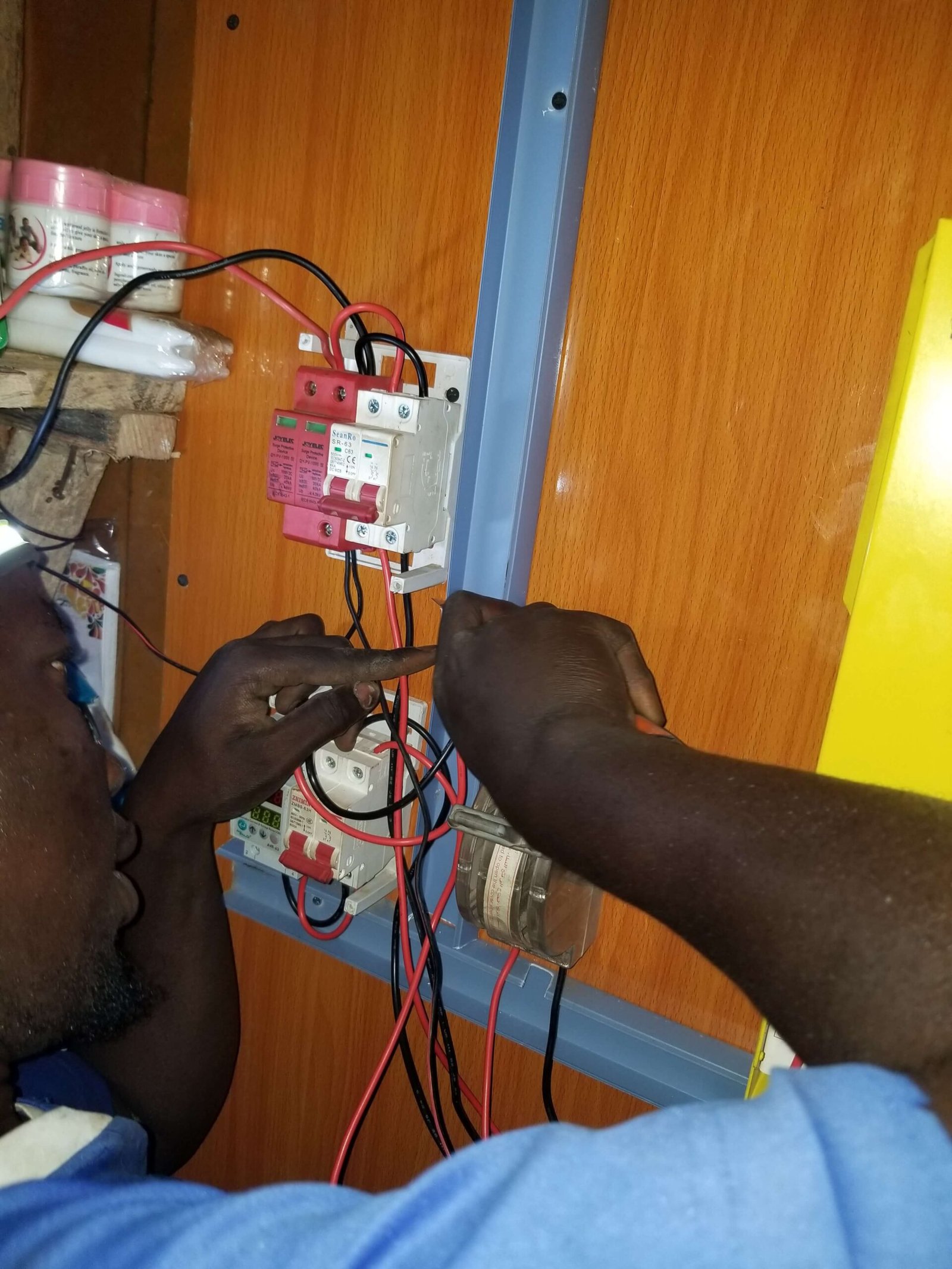
A 1kVA solar system is one of the most common entry points for homeowners, tenants, small offices and businesses looking to reduce their dependence on the electricity grid and generators.
It is relatively small compared with the larger 3kVA, 5kVA and 10kVA systems used for bigger homes and businesses, but a properly designed 1kVA solar system can still provide useful backup power for essential appliances.
The important part is understanding what a 1kVA system can realistically handle.
A 1kVA inverter does not mean you can connect every appliance in your home simply because the appliances are connected to solar. The inverter has a limited output, while the battery has a limited amount of stored energy. The solar panels also have a limited charging capacity.
So, when someone asks about a 1kVA solar system, there are actually three different questions to answer:
How much power can the inverter supply?
How much energy can the battery store?
How much energy can the solar panels produce during the day?
Understanding these three things will help you choose the right system and avoid paying for equipment that does not match your actual needs.
How Much Does a 1kVA Solar System Cost in Nigeria in 2026?
There is no single fixed price for a 1kVA solar system in Nigeria because the specification can vary considerably.
A basic system using a tubular battery and relatively modest solar-panel capacity can cost less than a system using a lithium battery, higher-quality panels and more comprehensive protection equipment.
Current 2026 Nigerian market guides put complete 1kVA systems broadly around ₦650,000 to ₦1.8 million, while other current market examples put a standard installed 1kVA system around ₦650,000 to ₦950,000 and lithium-based systems around ₦900,000 to ₦1.35 million.
A current example of a complete 1kVA package uses a 1kVA hybrid inverter, a 12.8V 200Ah LiFePO4 battery and two 600W solar panels, with the advertised package price around ₦940,000. Another Nigerian seller currently lists a 1kVA system with a 220Ah tubular battery and four 180W panels at about ₦1.1 million. These examples demonstrate why two systems both advertised as “1kVA” can have noticeably different prices and specifications.
For budgeting purposes, a practical range is:
| 1kVA System Type | Approximate 2026 Cost |
|---|---|
| Basic backup/inverter setup | ₦450,000 – ₦750,000 |
| Standard 1kVA solar system | ₦650,000 – ₦1,000,000 |
| 1kVA system with lithium battery | ₦900,000 – ₦1,350,000+ |
| Higher-specification complete system | ₦1,200,000 – ₦1,800,000+ |
These are indicative figures, not fixed quotations. Prices can change according to equipment brand, battery capacity, solar panel wattage, installation requirements and market conditions.
What Exactly Is a 1kVA Solar System?
A 1kVA solar system normally refers to a solar power system built around an inverter rated at approximately 1kVA.
Depending on the particular inverter, this may correspond to around 800W or 1,000W of usable AC output.
This distinction matters.
kVA is not exactly the same thing as watts.
The actual usable wattage depends on the inverter’s power factor and manufacturer specifications.
For practical planning, however, many small residential systems in this category are treated as approximately 1,000W-class systems.
That means you should not plan to operate a continuous 1,500W load on a 1kVA inverter simply because you have enough battery capacity.
The battery might contain enough energy, but the inverter still has to be capable of delivering the required power.
The Main Components of a 1kVA Solar System
A complete 1kVA installation can contain several components, not just the inverter.
The main components are:
Solar inverter
Solar batteries
Solar panels
Mounting structure
DC and AC cables
Protection devices
Changeover or bypass arrangement
Earthing system
Installation and commissioning
The exact components depend on whether you are installing an off-grid system, hybrid system or a backup inverter system.
1. The 1kVA Solar Inverter
The inverter is effectively the control centre of the system.
Solar panels and batteries store and produce electricity in DC form, while most household appliances use AC electricity.
The inverter converts the available DC power into usable AC power.
A hybrid inverter can also manage electricity from different sources, such as solar panels, batteries and the grid.
When choosing a 1kVA inverter, it is important to look beyond the number “1kVA”.
You should consider the inverter’s:
- Continuous output power
- Surge capacity
- Battery voltage
- Maximum solar input
- MPPT voltage range
- Maximum charging current
- Output waveform
- Protection features
- Warranty
- Compatibility with your battery
A cheap inverter may appear attractive initially, but the specifications are more important than the advertised capacity.
2. The Battery
The battery determines how much stored energy is available when the solar panels are not producing enough power.
This is particularly important at night and during power outages.
A 1kVA inverter with a small battery can operate appliances, but the backup period may be short.
A larger battery can provide longer backup, provided the inverter and charging system are designed to support it.
For a 1kVA system, you may encounter battery configurations such as:
12V 100Ah
12V 150Ah
12V 200Ah
12V 220Ah
or a lithium battery expressed in kWh.
The right choice depends on the intended loads and backup requirement.
3. Solar Panels
Solar panels provide the energy needed to recharge the battery and power the loads during daylight hours.
A 1kVA inverter does not necessarily mean you should install exactly 1kW of solar panels.
The appropriate panel capacity depends on the inverter’s maximum PV input and the amount of energy you need to produce each day.
For example, some current 1kVA packages use approximately 1.0kW to 1.2kW of solar-panel capacity. One current package uses two 600W panels with a 1kVA inverter and a 12.8V 200Ah lithium battery.
Another current Nigerian package uses four 180W panels, giving a total panel capacity of 720W.
This demonstrates that there is no single panel configuration that defines a 1kVA system.
The panels should be selected according to the inverter’s specifications and the required daily energy production.
4. Mounting Structure
The solar panels need to be securely mounted.
For a roof installation, the mounting arrangement needs to be appropriate for the roof structure and panel type.
The panels should also be positioned to minimise shading and provide suitable exposure to sunlight.
A poorly positioned panel array can produce significantly less energy than expected even when the panels themselves are good quality.
5. Cables and Protection
Cabling is an important part of the installation and should not be treated as an afterthought.
A complete installation can require:
Solar DC cables
Battery cables
AC cables
DC isolators
AC breakers
Fuses
Surge protection
Earthing
Changeover or bypass equipment
The exact protection arrangement depends on the system design.
Using inappropriate cables or protection equipment can affect system performance and safety.
How Many Solar Panels Do You Need for a 1kVA System?
There is no universal number.
It depends on the wattage of each panel and the inverter’s solar-input specification.
For example:
2 × 300W panels = 600W
2 × 450W panels = 900W
2 × 550W panels = 1,100W
2 × 600W panels = 1,200W
All four configurations can be described as a solar array for a 1kVA-class system, but they are not equivalent.
The correct arrangement depends on the inverter’s maximum PV input and voltage range.
You should therefore check the inverter specification before deciding how many panels to buy.
Can a 1kVA Solar System Run a Refrigerator?
It can, but this requires careful consideration.
A refrigerator does not necessarily consume its maximum rated power continuously, but the compressor can have a higher starting requirement.
The inverter must therefore be capable of handling the refrigerator’s starting characteristics.
The battery also needs enough energy to support the refrigerator along with whatever other appliances are operating.
For example, a system might be able to run:
Refrigerator + lights + TV + router
But adding several fans, a freezer and other loads at the same time could push the system beyond its practical operating limit.
The answer depends on the actual appliances rather than simply the fact that the inverter is rated at 1kVA.
What Appliances Can a 1kVA Solar System Power?
A properly designed 1kVA system is generally most suitable for essential and relatively low-power loads.
Typical loads can include:
Lighting
LED bulbs are particularly suitable because they provide useful illumination while consuming relatively little power.
Fans
One or more energy-efficient fans may be possible depending on their wattage and what else is operating.
Television
A television is normally a reasonable load for a small inverter system.
Decoder
A decoder can usually operate alongside a television without placing a significant load on a properly sized 1kVA system.
Wi-Fi Router
A router consumes relatively little power and can often remain operational for long periods on a small battery system.
Laptop
A laptop and charger are generally suitable for a 1kVA system.
Phone Charging
Phone and small-device charging requires relatively little power.
Small Electronics
Other low-power electronics can be used provided the total connected load remains within the inverter’s limits.
Example of a 1kVA Essential Load
Consider a household with the following approximate loads:
| Appliance | Approx. Power |
|---|---|
| 4 LED bulbs | 40W |
| 2 fans | 100W |
| Television | 100W |
| Decoder | 20W |
| Wi-Fi router | 15W |
| Laptop | 65W |
| Phone charging | 20W |
| Estimated total | 360W |
These figures are only examples because actual appliance consumption varies.
At an estimated 360W load, a 1kVA inverter has considerably more headroom than it would at a 900W or 1,000W load.
This is generally a more sensible way to use a small inverter system.
Rather than trying to operate the maximum possible load continuously, many users use a 1kVA system for their most important appliances.
Can a 1kVA Solar System Power an Air Conditioner?
Generally, a standard 1kVA system is not the appropriate choice for running a typical household air conditioner.
An air conditioner can require substantial operating power and may have significant starting or compressor-related demands depending on the unit.
Even an inverter-type air conditioner can consume more power than a small 1kVA system is designed to handle, especially when other household appliances are running.
If air conditioning is one of your priorities, a larger inverter and appropriately sized battery and solar array should normally be considered.
This is one reason it is important to determine your actual appliance list before choosing a system.
Can a 1kVA System Power a Freezer?
It may be possible with the right equipment and load management, but this should not be assumed.
A freezer has a compressor and can have a higher starting requirement.
If you want a 1kVA system to power a freezer, the installer should consider:
The freezer’s rated power
Starting characteristics
Other appliances operating at the same time
Battery capacity
Inverter surge rating
A system that can comfortably power lights and a television may behave very differently when a compressor-based appliance is added.
Can a 1kVA Solar System Power an Electric Iron?
An electric iron is generally not a good match for a small 1kVA inverter.
Many irons consume well above 1,000W.
Even if the appliance does not operate continuously at its maximum rating, switching it on can push a small inverter beyond its capacity.
This is an example of why appliance selection matters more than simply looking at the size of the house.
A 1kVA system can be excellent for essential electronics and lighting but unsuitable for high-power heating appliances.
Can a 1kVA Solar System Power a Washing Machine?
It depends on the washing machine, but caution is required.
The motor can have starting demands, and the machine may consume considerably more power than small electronic appliances.
If you want to operate a washing machine from solar, the inverter capacity, surge rating and battery should be checked against the actual machine specification.
For many households, a larger inverter would be more appropriate.
How Long Can a 1kVA Solar System Provide Backup?
The inverter size does not determine backup time.
The battery does.
For example, consider a 12V 200Ah battery:
12V × 200Ah = 2,400Wh
or approximately:
2.4kWh nominal energy
The amount actually available to the appliances depends on the battery chemistry, recommended depth of discharge, inverter efficiency and other losses.
Suppose the usable energy available to the system is approximately 1.9kWh after accounting for the battery’s recommended operating range.
At a 300W average load:
1,900Wh ÷ 300W ≈ 6.3 hours
At a 600W average load:
1,900Wh ÷ 600W ≈ 3.2 hours
These are simplified examples, not guaranteed runtime figures.
Actual backup time can be affected by battery condition, temperature, inverter efficiency and changes in appliance consumption.
Tubular Battery or Lithium Battery for a 1kVA System?
This is one of the biggest decisions affecting the price of a small solar system.
Tubular battery
Tubular batteries generally have a lower upfront cost and remain popular in Nigeria.
A typical 200Ah tubular battery may provide a relatively affordable way to build a small backup system.
However, lead-acid batteries normally have more limitations regarding depth of discharge, maintenance and cycle life.
Lithium battery
Lithium batteries, particularly LiFePO4 batteries, generally cost more initially.
However, they can offer deeper usable capacity, longer cycle life and lower maintenance.
A current 1kVA Nigerian package using a 12.8V 200Ah LiFePO4 battery, for example, provides approximately 2.56kWh of nominal battery storage.
For someone who expects to cycle the battery frequently, the higher initial cost may be worth considering alongside the expected service life.
How Much Battery Do You Need for a 1kVA Inverter?
The answer depends on your required backup time.
Someone who only wants three hours of evening backup for lights, fans and television will have different requirements from someone who wants to operate those appliances throughout the night.
You should therefore start with the load and desired runtime.
For example:
300W average load × 6 hours = 1.8kWh
That gives you an approximate energy requirement before allowing for system losses and battery operating limits.
If the desired backup time increases to 10 hours:
300W × 10 hours = 3kWh
The battery requirement has therefore increased substantially even though the inverter remains 1kVA.
This is why buying a larger battery does not necessarily mean buying a larger inverter.
How Much Solar Panel Capacity Does a 1kVA System Need?
Again, it depends on how much energy you need to recover during the day.
A system with a 2.5kWh battery bank may need a different solar array from a system with a 5kWh battery bank.
The installer should consider:
Daily energy consumption
Battery capacity
Available sunlight
Panel efficiency
System losses
Inverter charging limits
Expected daytime loads
As a simple illustration, a 1kW solar array does not necessarily produce 1kWh every hour of the day. Solar production changes throughout the day according to sunlight conditions, panel orientation, shading, temperature and other factors.
1kVA Solar System for a One-Bedroom Apartment
A 1kVA system can be a practical option for a small apartment if the homeowner focuses on essential loads.
For example, the system could be designed around:
Lighting
Fans
Television
Decoder
Router
Laptop
Phone charging
A refrigerator may also be possible if the system is properly designed around its starting and running requirements.
The system should not, however, be expected to power every appliance in the apartment simultaneously.
1kVA Solar System for a Small Office
A small office can also benefit from a 1kVA system.
A carefully designed setup could support:
Computers
Internet router
Lighting
Phone charging
Small electronics
This can be particularly useful for maintaining basic operations during grid outages.
However, printers, photocopiers, air conditioners, electric kettles and other higher-power equipment need to be considered separately.
1kVA Solar System for a Shop
For a small shop, the appropriate configuration depends heavily on the equipment being used.
A shop selling general goods may mainly require lighting, a fan, POS equipment and a small television.
A frozen-food business, restaurant or shop with refrigeration equipment will have substantially different energy requirements.
The system should therefore be designed around the actual business equipment rather than choosing 1kVA simply because it is affordable.
Important: 1kVA Does Not Mean 1kWh
These terms are often confused.
1kVA refers primarily to the inverter’s apparent power rating.
kWh refers to stored or consumed energy.
For example, a 1kVA inverter could be connected to a battery storing several kilowatt-hours of energy.
The inverter determines how much power can be supplied at one time.
The battery determines how much energy is available over time.
This distinction is essential when comparing solar quotations.
Should You Buy a 1kVA System or a Larger One?
If your electricity requirements are modest, there is no need to purchase a very large inverter simply because a larger system sounds better.
A properly designed 1kVA system may be sufficient for essential loads.
However, if you know that you want to run:
Multiple refrigerators/freezers
Air conditioners
Water pumps
Electric irons
Microwaves
Washing machines
Electric cookers
or several high-power appliances simultaneously, a 1kVA system is unlikely to be suitable.
In that situation, the correct approach is to calculate the load and determine the appropriate inverter size.
What Makes a 1kVA Solar System More Expensive?
The inverter rating is only one factor.
A 1kVA system can become more expensive when you choose:
Lithium battery storage
Higher-capacity batteries
Higher-wattage solar panels
Premium inverter brands
Additional protection equipment
Long cable runs
More complex roof installation
Additional electrical work
Larger solar arrays
More sophisticated monitoring and control
This explains why one installer may quote ₦700,000 for a 1kVA system while another quotes more than ₦1 million.
The specifications need to be compared before the prices can be meaningfully compared.
What to Check Before Buying a 1kVA Solar System
Before paying for a package, ask for the exact specification.
You should know:
Which inverter model is included?
What is its continuous output in watts?
What battery type and capacity are included?
How many solar panels are included?
What is the wattage of each panel?
Is installation included?
Are mounting materials included?
Are cables and protection devices included?
What warranty is provided?
What appliances is the installer designing the system to run?
A quotation that simply says “1kVA solar system” does not provide enough information to determine what you are actually buying.
Professional 1kVA Solar System Installation in Nigeria
The quality of the installation is just as important as the equipment.
The inverter, battery and solar panels need to work together as a properly designed system.
At PA DigiTech Solar, we can assess your intended appliances and backup requirements before recommending a 1kVA configuration.
The objective is to determine whether 1kVA is actually suitable for your needs and, if it is, select the appropriate battery, solar-panel capacity and supporting equipment.
Our services include solar system design, inverter installation, solar panel installation, battery installation and complete solar power system installation for homes and businesses.
If you are considering a 1kVA system, you can contact PA DigiTech Solar on 07068853073 for a system assessment and quotation.
Final Thoughts
A 1kVA solar system can be a useful and relatively affordable way to provide backup electricity in Nigeria, particularly when the system is designed around essential loads.
It can be suitable for lighting, fans, television, internet equipment, laptops, phone charging and other relatively low-power appliances. A refrigerator or freezer may also be possible depending on the equipment and system design.
However, a 1kVA inverter is not designed to power an entire modern home with multiple high-power appliances.
The most important thing is therefore not to ask only:
“How much does a 1kVA solar system cost?”
Ask instead:
“What do I want the system to power, for how long, and how much energy will those appliances consume?”
Once those questions are answered, it becomes much easier to determine the appropriate inverter, battery and solar-panel configuration.
For a properly designed 1kVA solar system in Nigeria, contact PA DigiTech Solar on 07068853073 to discuss your appliances, backup requirements and installation needs.