
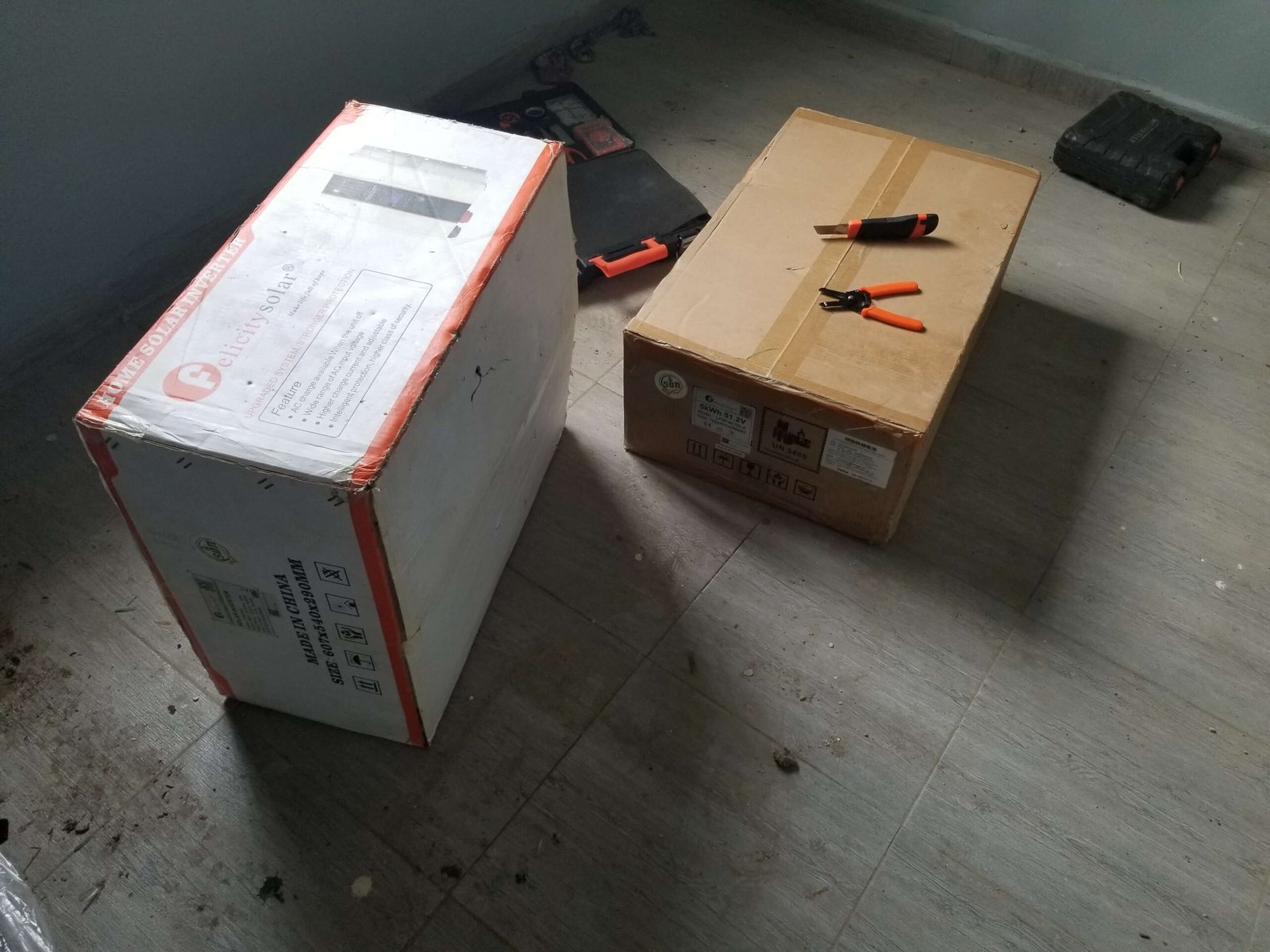
If you are planning to install a solar or inverter system in Nigeria, the battery is one of the most important components to get right. The inverter determines how much power your system can deliver at a particular time, while the battery determines how much energy you can store and how long your appliances can continue running when there is no grid power or sunlight.
This is why two solar systems with similar inverter capacities can have very different backup times and prices.
So, how much is a solar battery in Nigeria in 2026?
The answer depends on the battery technology, capacity, voltage, brand, usable capacity and overall quality. Current Nigerian market prices show that a 12V 200Ah tubular battery can cost roughly ₦155,000 to ₦420,000, while 5kWh lithium batteries can range from around ₦995,000 to over ₦2 million depending on the model and supplier. Other current market guides place 5kWh lithium batteries around ₦700,000 to ₦1.2 million, showing just how much prices can vary between brands and sellers.
For this reason, buying a battery simply because it has the lowest price is not always the best way to reduce the cost of a solar installation.
This guide explains the current solar battery prices in Nigeria in 2026, the differences between lithium, tubular and deep-cycle batteries, how much battery capacity you may need, and what to consider before spending money on a battery bank.
Solar Battery Prices in Nigeria in 2026
Here is a practical overview of current market ranges.
| Battery Type | Typical Capacity | Approximate 2026 Price |
|---|---|---|
| Tubular | 12V 100Ah | ₦130,000 – ₦250,000 |
| Tubular | 12V 150Ah | ₦200,000 – ₦320,000 |
| Tubular | 12V 200Ah | ₦155,000 – ₦420,000 |
| Tubular | 12V 220Ah | ₦280,000 – ₦450,000 |
| GEL / Deep-Cycle | 12V 100Ah | ₦150,000 – ₦280,000 |
| GEL / Deep-Cycle | 12V 200Ah | ₦280,000 – ₦450,000 |
| Lithium LiFePO4 | 12V 100Ah | ₦180,000 – ₦360,000 |
| Lithium LiFePO4 | 12V 200Ah | ₦315,000 – ₦550,000 |
| Lithium | 48V 100Ah / 5kWh | ₦700,000 – ₦2,148,000 |
| Lithium | 10kWh | ₦1.4 million – ₦3.1 million |
| Lithium | 15kWh | ₦2.3 million – ₦4.2 million+ |
These are indicative market ranges, not fixed retail prices. Actual prices can change according to brand, exchange rates, battery chemistry, warranty, availability, supplier and whether you are buying an individual battery or a complete solar package. Recent Nigerian market guides show similarly wide ranges.
A professional installer should therefore size the battery first and then compare suitable products rather than starting with a battery brand or price.
Why Solar Battery Prices Are So Different
Two batteries can both be advertised as “200Ah” and have very different prices.
The reason is that Ah alone does not tell you everything about a battery.
Battery voltage matters. Chemistry matters. Usable capacity matters. Expected cycle life matters. Charging characteristics matter. The battery management system matters in lithium batteries. Warranty and manufacturer support also affect the price.
For example, a 12V 200Ah battery has a nominal energy capacity of:
12V × 200Ah = 2,400Wh
That is approximately 2.4kWh of nominal storage.
However, you should not assume that the entire 2.4kWh will be available for regular use. The amount you can practically use depends heavily on the battery chemistry and the depth of discharge.
This is one reason comparing a 200Ah tubular battery directly with a lithium battery without looking at usable energy can be misleading.
Lithium vs Tubular vs Deep-Cycle Batteries
The three categories you will commonly encounter when shopping for an inverter or solar battery in Nigeria are lithium, tubular lead-acid and other deep-cycle batteries such as GEL or AGM.
Each has a different price and operating characteristic.
Lithium Solar Batteries
Lithium batteries, particularly LiFePO4 (Lithium Iron Phosphate) batteries, have become increasingly popular for residential and commercial solar installations.
Their main attraction is that they can generally provide a much larger proportion of their rated capacity for regular use compared with traditional lead-acid batteries.
They are also lighter, require less routine maintenance and can support a large number of charge and discharge cycles when properly selected and installed.
The disadvantage is the initial purchase price.
A 5kWh lithium battery may cost considerably more upfront than a bank of conventional batteries. Current Nigerian listings show 5kWh lithium prices ranging from under ₦1 million to more than ₦2 million depending on the product and seller.
However, the purchase price is only one part of the calculation.
If a battery is used heavily every day, its expected service life and usable capacity can have a major effect on the long-term cost.
Tubular Batteries
Tubular batteries are still widely used in Nigerian inverter and solar installations because they provide a more affordable entry point.
A typical 12V 200Ah tubular battery is often found in the region of ₦155,000 to ₦420,000, although particular brands and models can fall outside this range.
Tubular batteries can be suitable for systems where the initial budget is important and the expected usage pattern is appropriate.
However, they generally require more attention than lithium batteries. Depending on the particular battery, maintenance requirements, charging conditions, ventilation and usage can all affect service life.
A common mistake is to compare only the purchase price.
A tubular battery that costs less initially may not necessarily be the cheapest option over several years if it requires earlier replacement.
Deep-Cycle Batteries
The term deep-cycle battery refers to batteries designed to provide sustained energy over longer periods rather than simply delivering a short burst of starting current.
GEL and AGM batteries are examples of sealed lead-acid battery technologies that can be used in backup and solar applications.
They are sometimes attractive where users want a relatively simple battery solution without the maintenance associated with some flooded lead-acid batteries.
However, the specific battery specification is important. Not every battery marketed for inverter use is equally suitable for frequent solar cycling.
How Much Does a 200Ah Solar Battery Cost in Nigeria?
The 200Ah rating is one of the most commonly searched specifications because 12V 200Ah batteries are frequently used in inverter systems.
Current 2026 market guides put 12V 200Ah tubular batteries broadly around ₦155,000 to ₦420,000, while 12V 200Ah lithium batteries can be roughly ₦315,000 to ₦550,000 depending on the model and supplier.
But there is an important point to understand.
A 200Ah battery is not automatically suitable for every inverter.
For example, if an inverter system requires a 48V battery bank, you cannot simply connect one 12V battery and expect it to provide the required voltage. Several batteries may need to be connected in series, or a purpose-built high-voltage battery module may be used.
This is why battery selection should be based on the complete system design, not just the battery’s Ah rating.
How Much Is a 5kWh Lithium Battery in Nigeria?
The 5kWh lithium battery has become an important size for residential solar systems.
Current 2026 market information places 5kWh lithium batteries broadly between about ₦700,000 and ₦2.148 million, depending on brand, specification, warranty and supplier. Some current Nigerian retail guides place common 48V 100Ah units around ₦1.2 million to ₦1.9 million.
A 5kWh battery can be suitable for many home systems, but whether it is enough depends on what you want to run.
A home using only lights, fans, television, internet equipment and a few other essential appliances may have very different requirements from a home running air conditioners, freezers, pumps and other heavy loads.
For example, running a 1kW load continuously for five hours would theoretically require 5kWh of energy before accounting for system losses and battery operating limits.
That is why battery capacity should be calculated from your actual energy consumption and backup requirement.
How Much Is a 10kWh Lithium Battery?
For larger homes, offices and commercial applications, 10kWh lithium storage is becoming increasingly common.
Current Nigerian market guides show 10kWh lithium batteries at approximately ₦1.4 million to ₦3.1 million, with some products falling outside that range.
A 10kWh battery does not mean that every appliance in a building can run for 10 hours.
The battery stores energy. The inverter must still be capable of supplying the required power.
For example, a 10kWh battery connected to a properly sized inverter could provide considerably different backup times depending on whether the connected load is 500W, 2kW or 5kW.
This distinction between power and energy is one of the most important things to understand when buying a solar system.
Battery Capacity: Ah vs kWh
Battery advertisements often use Ah, while modern lithium storage systems are increasingly advertised in kWh.
This can make comparisons confusing.
The basic relationship is:
Energy (Wh) = Voltage × Amp-hours
So:
12V × 200Ah = 2,400Wh = 2.4kWh
Likewise:
24V × 200Ah = 4.8kWh
And:
48V × 100Ah = 4.8kWh
This demonstrates why simply saying that one battery is “200Ah” and another is “100Ah” does not tell you which one stores more energy.
The voltage must also be considered.
Why Usable Battery Capacity Matters
A battery’s label capacity is not necessarily the amount of energy you should regularly extract from it.
This is where depth of discharge (DoD) becomes important.
For example, if a 12V 200Ah battery has a nominal capacity of 2.4kWh and you use only approximately 50% of it regularly, the practical energy available is around 1.2kWh before considering other system losses.
Lithium batteries can generally be operated at a deeper depth of discharge than traditional lead-acid batteries, which means two batteries with apparently different specifications may provide more comparable usable energy than their labels suggest.
This is one reason professional solar system design should look at usable energy, rather than simply counting batteries.
How Many Batteries Do You Need?
There is no single answer.
The number depends on:
- Your inverter voltage
- Your required backup time
- Your appliance load
- Battery capacity
- Battery chemistry
- Maximum recommended depth of discharge
- Charging capacity
- Solar panel capacity
- Expected daily energy consumption
Consider a simple example.
Suppose you need approximately 5kWh of usable battery energy.
You could approach this with several conventional batteries or a lithium battery system designed around approximately 5kWh of storage.
The correct option depends on the required voltage, budget, available installation space and how frequently the batteries will be cycled.
For larger installations, it can make more sense to use a 48V lithium battery system rather than assembling a large number of individual 12V batteries.
Battery Price Is Only Part of the Solar System Cost
When someone asks, “How much is a solar battery in Nigeria?”, they are sometimes actually trying to determine the total cost of installing solar.
The battery is only one part of the system.
A complete installation may also require:
Solar panels + inverter + batteries + mounting structure + DC cables + AC cables + breakers + fuses + isolators + earthing + protection devices + installation labour + configuration and commissioning
The final price therefore depends on the complete system.
For example, buying a relatively inexpensive battery and connecting it to an unsuitable inverter can create problems that are much more expensive to correct later.
What Determines the Price of a Solar Battery?
Battery chemistry
Lithium batteries generally cost more upfront than traditional lead-acid batteries.
Capacity
A larger battery stores more energy and normally costs more.
Voltage
A 48V battery system is not directly comparable with a 12V battery simply because one has a higher or lower Ah rating.
Brand
Established manufacturers and recognised models may cost more because of product quality, warranty and support.
Battery management system
Lithium batteries normally incorporate a Battery Management System that helps monitor and protect the battery.
Cycle life
A battery designed for frequent cycling can have a different price from a battery intended for lighter use.
Warranty
A battery with meaningful manufacturer or distributor warranty support may cost more than an unknown product with little after-sales support.
Market and exchange rate
Solar equipment prices in Nigeria can change as import costs, exchange rates and local availability change. Current 2026 sources explicitly note that battery prices are subject to market changes.
Should You Buy Lithium or Tubular?
This depends on your system and budget.
If your priority is a lower initial investment, tubular batteries may be worth considering.
If your priority is longer service life, deeper usable capacity, lower routine maintenance and a more compact storage solution, lithium may be more suitable.
For a system that is expected to cycle heavily every day, it is particularly important to consider the long-term cost rather than looking only at today’s purchase price.
A recent Nigerian comparison illustrates this difference by comparing a large lithium battery bank with a larger tubular bank sized to provide similar usable energy. The tubular option had a lower initial battery cost in that example, but its shorter expected life meant that replacement costs could become significant over a longer period.
That does not mean lithium is automatically the right choice for every property. The correct decision depends on the load, usage pattern, budget and system design.
What Battery Size Do You Need for a House?
The answer should start with the appliances rather than the number of bedrooms.
A three-bedroom house with several air conditioners, freezers, water pumps and other heavy appliances may require substantially more battery storage than another three-bedroom house with mostly lighting, fans, television, refrigeration and electronics.
A proper assessment should consider:
What appliances do you use?
How much power does each appliance consume?
How many hours do you want to run each appliance?
Which appliances must remain on during an outage?
How long do you want the battery to provide backup?
Will solar panels recharge the battery during the day?
These answers provide a much better basis for selecting battery capacity.
Battery Sizing for Air Conditioners
Air conditioners require particular attention because they can consume significant power and may have high starting or operating demands depending on the equipment.
A battery that comfortably powers lighting, fans and a television may not provide the expected backup when one or more air conditioners are added.
This does not mean that air conditioning cannot be supported by solar.
It means the inverter, solar array and battery bank must be designed around the actual air-conditioning load.
For homes that want to operate AC during outages, a professional load assessment is particularly useful before purchasing batteries.
What About Freezers and Refrigerators?
Refrigerators and freezers are also important when calculating battery requirements.
Although their compressors cycle on and off rather than consuming their maximum rated power continuously, the system must still be able to handle their starting and operating requirements.
If your solar system is intended to keep refrigeration running during long power outages, battery capacity should be calculated around the expected operating pattern rather than simply using the appliance’s nameplate rating.
Can You Add More Batteries Later?
In many systems, yes, but this should be considered during the original design.
The inverter must support the proposed battery configuration, and batteries connected together should be appropriately matched.
For lithium systems, communication between the battery’s BMS and inverter may also need to be considered.
Adding a completely different battery to an existing battery bank without proper assessment can cause charging, balancing or performance problems.
If you expect your energy needs to increase later, it is better to tell the installer during the original design.
The system can then be designed with future expansion in mind.
Things to Check Before Buying a Solar Battery
Don’t judge a battery by its price alone.
Before buying, check the battery’s:
Voltage and capacity: Confirm that it matches your inverter system.
Chemistry: Know whether you are buying lithium, tubular, GEL, AGM or another technology.
Usable capacity: Understand the recommended depth of discharge.
Cycle life: Look at the manufacturer’s specifications rather than relying solely on sales claims.
Warranty: Confirm what is covered and for how long.
Charging requirements: The inverter and solar charging system must be compatible.
Physical size: Make sure there is suitable installation space.
Weight: This is particularly important with large lead-acid battery banks.
BMS specifications: For lithium batteries, understand the battery management system and communication requirements.
Manufacturer and model: Avoid buying an unknown battery simply because it has a low advertised price.
Why Cheap Solar Batteries Can Become Expensive
A battery is not an area where buying purely on price always makes sense.
Suppose a cheaper battery has a short useful life and needs to be replaced repeatedly. The initial saving can disappear over time.
There is also the cost of downtime.
For a business that depends on computers, refrigeration, security systems, internet equipment or other electrical loads, an unreliable battery can affect normal operations.
This is why the better question is not simply:
“What is the cheapest solar battery?”
It is:
“Which battery provides the required usable energy, reliability and service life at a reasonable overall cost?”
That is a much more useful way to approach a solar investment.
Professional Battery Installation in Nigeria
Choosing the correct battery is only one part of the job.
Battery installation also requires attention to cable sizing, protection, connections, polarity, ventilation where applicable, battery configuration and compatibility with the inverter and charging system.
For lithium systems, the battery’s BMS settings and inverter communication may also need to be configured correctly.
For larger battery banks, poor cable selection or incorrect connections can result in significant energy losses and unnecessary heating.
This is why battery installation should be treated as part of the overall solar system design rather than as a simple process of connecting batteries to an inverter.
Need Help Choosing the Right Solar Battery?
If you are unsure whether you need lithium, tubular or another type of battery, PA DigiTech Solar can assess your power requirements and recommend a suitable battery configuration based on your appliances, inverter capacity and expected backup time.
The goal should not simply be to sell you the biggest battery available. A properly designed system should balance capacity, performance, budget and future requirements.
PA DigiTech Solar provides solar system design and installation services for homes, offices, shops and other properties across Nigeria, including battery and inverter installation.
For enquiries, system assessment or a quotation, contact PA DigiTech Solar on 07068853073.
Frequently Asked Questions
How much is a solar battery in Nigeria in 2026?
Prices vary considerably. A 12V 200Ah tubular battery may cost roughly ₦155,000 to ₦420,000, while lithium batteries range from several hundred thousand naira for smaller units to several million naira for larger storage systems.
How much is a 5kWh lithium battery in Nigeria?
Current market guides show approximately ₦700,000 to over ₦2 million depending on the brand, model, warranty and supplier.
How much is a 10kWh lithium battery?
A 10kWh lithium battery can cost approximately ₦1.4 million to ₦3.1 million or more depending on the product and supplier.
Is lithium better than tubular?
They have different strengths. Lithium generally offers deeper usable capacity, lower maintenance and longer cycle life, while tubular batteries generally have a lower initial purchase price. The appropriate choice depends on the application and budget.
How many batteries do I need for a 5kVA inverter?
There is no single number. It depends on whether the inverter uses a 12V, 24V or 48V battery configuration and on the amount of backup energy required.
Can I use a car battery for solar?
A conventional car starting battery is not normally designed for repeated deep cycling in a solar backup system. A battery specifically designed for deep-cycle or solar applications is more appropriate.
How long does a solar battery last?
Battery lifespan depends on chemistry, usage, depth of discharge, temperature, charging and maintenance. Lithium batteries can generally provide substantially more cycles than conventional lead-acid batteries when properly operated.
Is a bigger battery always better?
Not necessarily. A battery should be matched to your energy consumption, inverter, solar charging capacity and desired backup time. An oversized battery can also require additional solar generation to recharge effectively.
Can I add more batteries to my existing solar system?
It may be possible, but the inverter, battery chemistry, voltage, capacity, age and configuration must be checked first. It is better to have the system assessed before adding batteries.
Final Thoughts
The cost of a solar battery in Nigeria depends on much more than the number printed on the battery.
Lithium, tubular and deep-cycle batteries have different characteristics, prices and applications. In 2026, lithium batteries generally require a higher initial investment, while tubular batteries remain a more affordable option for many buyers. However, usable capacity, cycle life, maintenance and replacement costs should all be considered before making a decision.
Most importantly, buy the battery for the system you actually need.
A proper load assessment can determine how much energy your home or business consumes, how much backup you require and what battery configuration can provide it.
If you need help designing or installing a solar system, contact PA DigiTech Solar on 07068853073 for professional guidance and installation services.